

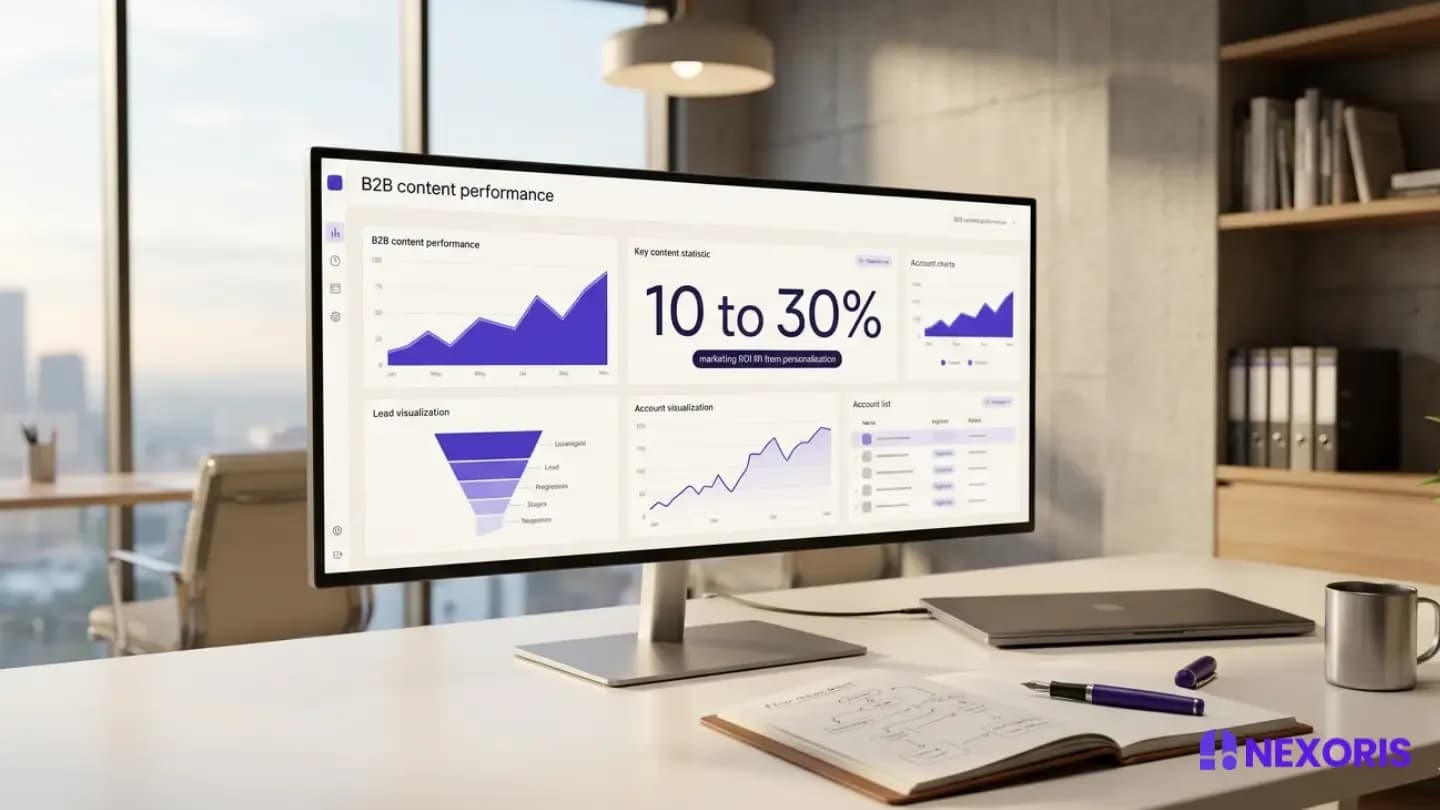
TL;DR: AI personalization in B2B content delivers a 10 to 15 percent revenue lift and 10 to 30 percent marketing ROI improvement for most companies (McKinsey, Next in Personalization). Across 20+ Nexoris Technologies engagements between 2025 and 2026, the lifts were tighter at 15 to 25 percent on conversion rate and roughly 20 percent on time-to-first-meeting, mostly from intent-aware sequencing rather than more content. This guide covers the 2026 numbers, the named platforms, the metrics that predict pipeline, and how to prove the ROI to a CFO.
Frequently Asked Questions (FAQs)
AI personalization in B2B delivers a 10 to 15 percent revenue lift and a 10 to 30 percent improvement in marketing ROI for most companies (McKinsey, Next in Personalization). Across Nexoris Technologies engagements between 2025 and 2026, the typical conversion rate lift was 15 to 25 percent within two quarters, and time-to-first-meeting fell by roughly 20 percent over the same period.
Marketing teams prove ROI by defining a single conversion event, baselining the metric before deployment, deploying the personalization layer in a controlled scope, measuring the delta against baseline, and attributing closed revenue back to the behavioural signals that triggered each personalization decision. Skipping the baseline step is the most common reason ROI claims get rejected by finance teams.
A realistic AI personalization conversion rate increase in B2B is 15 to 25 percent within two quarters, with a 10 to 15 percent revenue lift and engagement rate improvements of 20 percent or more. Teams with mature first-party data and a single integrated platform tend to land at the upper end of the range.
You compare AI personalization engines for B2B against intent signal quality, CRM and data stack integration, segmentation flexibility, attribution depth, and three-year total cost of ownership. The most-shortlisted platforms in 2026 are Adobe Journey Optimizer B2B Edition, Demandbase, 6sense, HubSpot Breeze, Mutiny, Drift, Persado, and Dynamic Yield.
The right one depends on your buying motion and existing stack, not on which platform has the most powerful feature set.
For ABM-led enterprises, Demandbase and 6sense lead the shortlist. For Adobe-stack enterprises, Adobe Journey Optimizer B2B Edition is the natural choice. For mid-market teams under $50 million in revenue, HubSpot Breeze and Mutiny typically deliver better ROI because of faster time-to-value and lower implementation overhead.
You personalize ROI models per account by combining the account's firmographics, the last 90 days of behavioural intent signals, historical conversion patterns from comparable closed accounts, the buying committee's role mix, and segment-specific deal-size assumptions.
The AI layer pattern-matches the account against your win-loss history, weights signals in real time, and produces a per-account expected revenue figure with a recommended next action. Anything more complex gets ignored by the sales team.
The ROI of being cited in AI-generated content is significant in 2026 because 94 percent of B2B buyers now use LLMs to synthesize research (6sense, 2025 Buyer Experience Report) and AI-referred buyers spend up to 3x more time on-page than traditional search visitors (Forrester).
Buyers arrive better informed, with shorter sales cycles, but if your brand is not in the AI's answer, you may never enter the consideration set.
Yes. AI-driven custom sales materials tighten the match between what the buying committee is asking and what the seller is sending, which reduces stalled-deal time and improves the accuracy of late-stage forecasts.
In Nexoris Technologies engagements where customised one-pagers and ROI memos replaced generic decks in late-stage deals, forecast variance fell by roughly 25 percent within two quarters, because forecasts began to track observable buyer behaviour instead of seller optimism.
Basic dynamic content swaps a name, company, or industry into a static template. AI personalization continuously analyses behavioural signals, account context, and historical patterns to choose what to surface, when to surface it, and how to sequence it across channels. The first is a mail-merge with extra steps.
The second is an active recommendation system that learns. The ROI difference between the two is roughly 5x, based on engagement-rate benchmarks across major B2B platforms.
Most B2B teams see measurable conversion lift within two quarters of a properly scoped AI personalization deployment, with full ROI defensible at the CFO level by the end of the third quarter.
The timeline is faster for teams with clean first-party data, slower for teams whose data lives in three disconnected systems and needs to be unified before personalization can be deployed cleanly.
