Hospital Management System in Nigeria: 2026 Buyer's Guide (EHR, EMR, Cost, NDPA)
Key Facts at a Glance SaaS HMS: ₦150K to ₦5M+ per year. Custom build: ₦4M to ₦25M. Annual maintenance: 15 to 20% of build cost. Payback period: 18 to 30 months.
NDPA 2023: patient data is sensitive. Breach notice in 72 hours.
Biggest delay risks: data migration and change management.
Hospital Management System in Nigeria: 2026 Buyer's Guide
If you run a hospital, clinic, or HMO in Nigeria and you are still working from paper files, scattered spreadsheets, or three software tools that do not share data, the question is not whether to digitise. It is what to choose, what it will actually cost, and how to avoid the kind of failed rollout that wastes 18 months and leaves your staff back on paper.
This guide gives you real prices, the rules you have to follow, the integrations that matter, and a clear way to decide between buying off-the-shelf and building custom. The costs and deployment patterns here come from healthcare projects delivered by Nexoris Technologies for Nigerian clients between 2025 and 2026.
Regulatory references draw on the National Health Insurance Authority Act 2022, the Nigeria Data Protection Act 2023, the Federal Ministry of Health's National Digital Health Policy, the HL7 FHIR specification, and the Medical and Dental Council of Nigeria's telemedicine guidelines. NHIA reform figures reflect publicly reported announcements from February and April 2025.
Quick Answer: What an HMS Costs in Nigeria in 2026
A hospital management system (HMS) is the central software that runs a Nigerian hospital, holding patient records, appointments, pharmacy, laboratory, billing, and HMO claim submission in one shared database. In 2026, a Nigerian hospital has three honest paths.
₦4M to ₦25M one-time, plus 15 to 20 percent annual maintenance
A small clinic running 10 to 20 patients a day rarely needs more than a SaaS plan. A 150-bed multi-specialty hospital with five HMO contracts and an in-house laboratory usually outgrows SaaS within two to three years. The right answer depends on size, claim volume, and how much your workflows differ from a standard template.
How Big Is the Nigerian Hospital Market in 2026?
Nigeria has roughly 4,000 hospitals, 35,000 primary healthcare centres, and over 50 licensed HMOs as of 2026, according to Federal Ministry of Health and NHIA registry data. That makes it one of the largest healthcare markets in Africa by absolute size, with significant scope for digitisation.
Healthcare provision is split across public hospitals (federal teaching hospitals, federal medical centres, state general hospitals, and local government PHCs), private hospitals ranging from single-site clinics to multi-site groups, and faith-based hospitals operating under the Christian Health Association of Nigeria and other bodies.
Each layer has different software needs. A private 50-bed hospital wants efficient billing and fast HMO claim turnaround. A teaching hospital needs research-grade record keeping and regulatory reporting. A faith-based mission hospital often needs strong offline capability and lower licence costs.
A primary healthcare centre needs a lightweight EMR with mother-and-child registers, immunisation records, and reporting into District Health Information System (DHIS2) where applicable.
Identifying which layer your facility belongs to saves months of evaluating tools that were never going to fit.
The Seven Modules That Run a Modern Hospital
A complete HMS runs seven modules from one shared database: electronic health records, appointment scheduling, pharmacy and inventory, laboratory information, billing and HMO claims, telemedicine, and reporting. A serious system runs all seven from one shared database.
A weak system stitches together separate tools, and the gaps show up in billing, reporting, and patient safety.
Electronic health records (EHR/EMR)
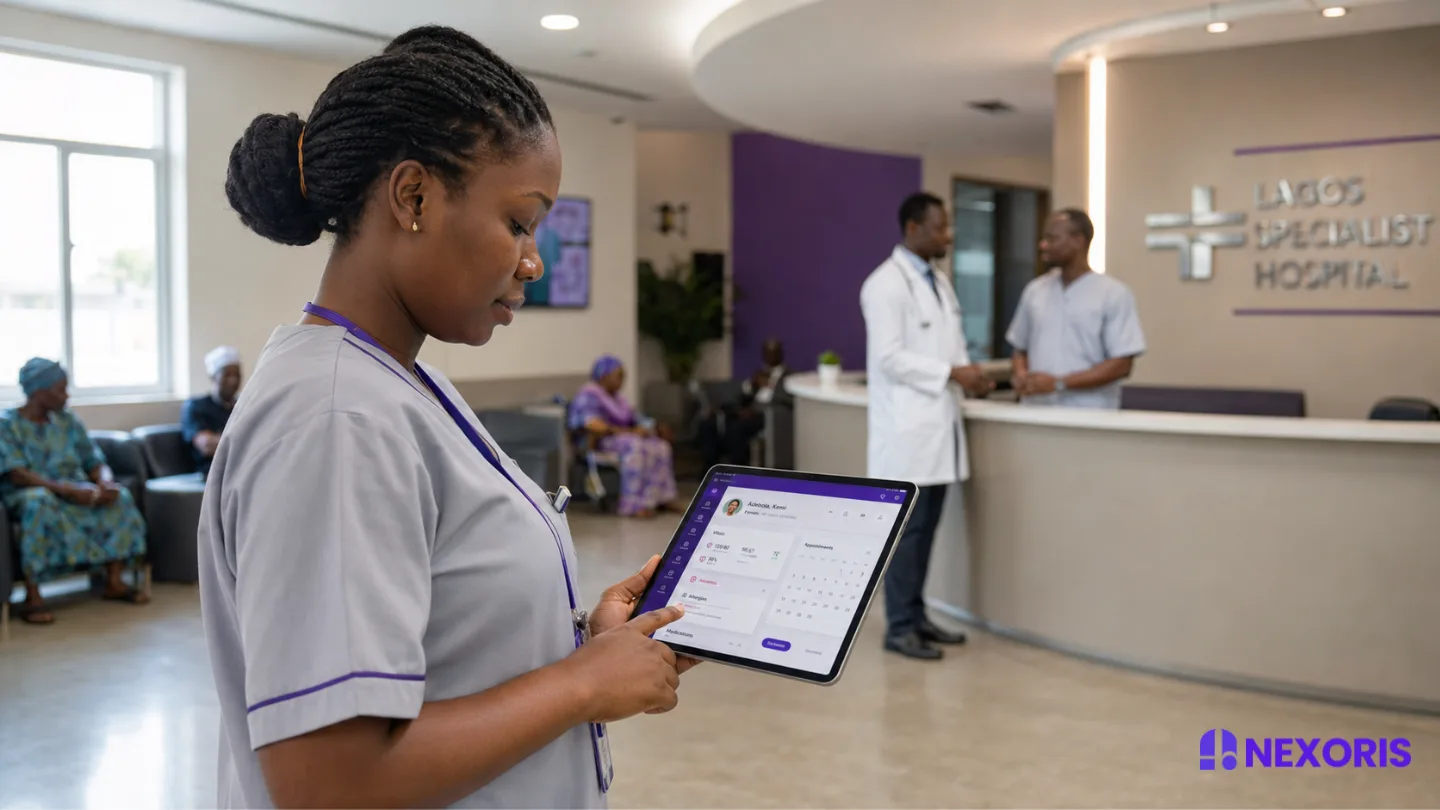
The clinical foundation of the system. It holds the patient's full history, including vitals, diagnoses, prescriptions, lab orders, and clinical notes. Doctors should be able to pull any patient's record in under five seconds from any consulting room. Records should be coded to ICD-10 for diagnoses and, where supported, SNOMED CT for clinical terminology.
Appointment scheduling and queue management
Patients book online, by phone, or through WhatsApp. The system schedules across doctors, consulting rooms, and equipment, and shows the front desk a real-time queue with expected wait times. A well-built scheduling module cuts no-show rates and reduces idle time between consultations.
Pharmacy and inventory
The pharmacy module tracks every drug from delivery to dispensing, flags expiries, manages reorder points, and links to the patient's prescription so dispensing is a single action rather than three paper forms. NAFDAC product codes should be supported so the correct drug is verified at the point of dispensing.
Laboratory information system
The laboratory module receives orders from doctors, tracks samples from collection to analysis, captures results, and pushes signed reports back into the patient's EHR without a paper runner. Direct integration with reference laboratories cuts hours of manual data entry per day.
Billing, payments, and HMO claims
The billing module captures every chargeable item across the patient's visit or stay, generates invoices, processes payments through Paystack, Flutterwave, Monnify, or Remita, and submits claims to NHIA, State Health Insurance Schemes, and HMOs in the format each requires. This module has the biggest effect on cash flow.
Telemedicine
Video consultations, follow-up appointments, and second opinions, with consultation notes saved directly to the EHR. Operations should follow the National Telemedicine Guidelines published by the Federal Ministry of Health, and all consultations must be conducted by MDCN-registered practitioners with the practitioner's ID attached to the clinical record.
Reporting and clinical analytics
Live dashboards for the medical director and finance lead, covering patient volume, revenue, claim status, drug stock, and staff productivity. Where required, the system should export data into DHIS2 format for public health reporting.
Module
Why It Matters
EHR/EMR
Faster, safer clinical decisions
Scheduling
Less idle time, fewer no-shows
Pharmacy
Less stockout, fewer expiries, less theft
Laboratory
Faster diagnostics, fewer lost results
Billing and claims
Stronger cash flow, fewer rejections
Telemedicine
New revenue, broader patient reach
Reporting
Better management decisions, faster
Build, Buy, or Start with Open Source
Buy SaaS if you run a single clinic or small hospital with standard workflows. Build custom if you have specialty workflows, multiple sites, deep HMO integration needs, or you want full ownership of the codebase. Start with open source if you have an in-house technical team or a long-term technical partner. The reasoning behind each path follows.
Buy a SaaS platform
The right choice if you run a single clinic or a small hospital with standard workflows, your team is small, and you do not have specialty needs that a generic platform cannot cover. You get the system live in weeks rather than months, and the vendor handles updates, hosting, and security.
Build custom
The right choice if you have specialty workflows, multiple sites, deep HMO and NHIA integration requirements, or a high volume of insured-patient claims. Teaching hospitals, large multi-site groups, and HMO carriers consistently choose this route. Full data ownership and a codebase you control are additional reasons to build.
For organisations comparing custom builds across software categories, our guide tocustom ERP software in Nigeria covers the same trade-off pattern in a different domain.
Start with open source
The right choice if you have an in-house technical team or a committed long-term technical partner. OpenMRS is a serious open-source EHR used in over 40 countries with a strong global community and a growing presence in African healthcare systems. The cost model shifts from licence fees to engineering, hosting, and maintenance, but the data and the codebase stay entirely yours.
Factor
SaaS
Custom
Open Source
Upfront cost
Low
High
Medium
Time to launch
4 to 12 weeks
6 to 12 months
4 to 9 months
Data control
Vendor's servers
Fully yours
Fully yours
Customisation
Limited
Unlimited
High
Long-term cost
Ongoing subscriptions
High upfront, lower annual cost
Engineering and hosting heavy
Regulatory fit (NHIA, SSHIA, HMOs)
Vendor's choice
Built to your needs
Built to your needs with engineering effort
For deeper guidance on choosing between paths and the procurement process behind a custom build, see our
software development vendor selection guide for Nigerian buyers.
The 2025 NHIA Reforms and What They Mean for Your Billing Team
The National Health Insurance Authority Act 2022 made health insurance mandatory for all residents and changed how money flows through Nigerian healthcare. Two adjustments announced in 2024 and 2025 carry the biggest weight for hospital billing operations.
In mid-2024, NHIA implemented an interim adjustment of a 60 percent capitation increase and a 40 percent fee-for-service increase as a temporary measure to stabilise the sector while a full actuarial review was completed.
Following that review, NHIA Director-General Dr. Kelechi Ohiri announced at a February 2025 stakeholders meeting with HMOs and healthcare providers in Abuja that capitation fees would increase by a further 93 percent and fee-for-service rates by 378 percent, effective April 2025, as reported by Nairametrics, BusinessDay, and Vanguard. T
hese rates were approved by the Minister for Health and Social Welfare, Professor Muhammad Ali Pate, and represent the largest single upward adjustment to provider payments in over a decade.
A second structural change changes how billing teams submit claims. Under the NHIA Act, fund management has moved from HMOs to State Social Health Insurance Agencies. HMOs may still collect contributions where appointed by an SSHIA, but the funds are held by the SSHIA.
Your HMS must be capable of submitting and reconciling claims through both channels, not just the one or two HMOs you have historically worked with. What this means in practice. An HMS that handles NHIA, SSHIA, and HMO claim formats in 2026, and that does so across multiple carriers, is the minimum standard for any hospital with a meaningful insured patient volume.
What an HMS Costs Nigerian Hospitals in 2026
An HMS in Nigeria costs ₦150,000 to ₦20M a year on SaaS, or ₦4M to ₦25M one-time on a custom build, plus 15 to 20 percent annual maintenance. The real total cost has four parts: licence or build, implementation, hardware and infrastructure, and ongoing operations. Most vendor quotes cover only the first part.
SaaS subscription pricing Nigerian and regional SaaS platforms typically price per bed, per user, or as a flat tier. Small clinic plans cost ₦150,000 to ₦400,000 a year. Mid-size hospital plans for 50 to 200 beds typically run ₦1.2M to ₦5M a year. Multi-site groups and large hospitals above 200 beds run ₦5M to ₦20M a year, depending on modules.
Custom build cost drivers A custom HMS costs ₦4M to ₦25M depending on modules, integrations, staff training, and data migration. A focused build covering EHR, scheduling, billing, and one HMO integration is at the lower end.
A full hospital platform with pharmacy, laboratory, telemedicine, multiple HMO and NHIA integrations, SSHIA reconciliation, and management reporting is at the higher end. Add 15 to 20 percent of build cost each year for ongoing maintenance.
Five costs most vendor quotes leave out Almost every hospital running an HMS deployment encounters at least three of these after signing.
Training: A 50-bed hospital needs 30 to 60 staff trained in batches over two to four weeks. Budget ₦300,000 to ₦1,500,000 in time and materials.
Hardware: Workstations, tablets, label printers, barcode scanners, and a server room or reliable cloud uplink. Budget ₦2M to ₦10M depending on the size of the facility.
Internet and power backup: Reliable broadband, a secondary ISP, and a generator or solar inverter sized for the workstations. Budget ₦300,000 to ₦2M upfront, plus ongoing fuel or power running costs.
Data migration: Moving paper records or legacy system data into the new system is consistently the most underestimated item. Budget ₦500,000 to ₦5M depending on volume and the condition of existing records.
Penetration testing: A health platform should be tested by a qualified third party before it goes live. Budget ₦500,000 to ₦2,500,000 for a proper test.
Five-year total cost of ownership. For a 100-bed hospital on a custom HMS, this is the realistic cost shape across build and operations.
Item
Year 1
Years 2 to 5 (each)
Build (one-time)
₦12,000,000
0
Hardware
₦5,000,000
₦500,000 to ₦1,000,000
Cloud hosting
₦1,200,000
₦1,500,000 to ₦2,200,000
Maintenance retainer
₦1,800,000
₦2,400,000 to ₦2,800,000
Training and change management
₦800,000
₦300,000
Year total
₦20,800,000
₦4,700,000 to ₦6,300,000
Five-year total: roughly ₦42,900,000. The build cost is less than a third of that figure. This is the number most quotes hide.
Worked ROI Example
A 100-bed Nigerian hospital running a custom HMS typically reaches break-even in 18 to 30 months and recovers around ₦78M in annual receivables through reduced claim rejections. Here is how that breaks down for a hospital seeing 8,000 outpatients and 1,200 inpatients a year, with a 35 to 40 percent insured patient volume.
At 2025 NHIA tariff levels, a hospital of this size would submit approximately ₦600M in annual HMO and NHIA claims. Based on patterns seen in Nexoris Technologies' healthcare engagements and widely reported in Nigerian HMO claims processing, a pre-HMS claim rejection rate of around 25 percent is a reasonable starting point for a hospital still running manual billing and paper-based submission.
Pre-HMS performance on those assumptions:
Average claim rejection rate: approximately 25 percent
Average days to settle an HMO claim: 65 days
Time per patient on registration and billing: 12 minutes
After deploying an HMS with NHIA, SSHIA, and HMO integrations and barcode-assisted billing, realistic targets based on Nexoris Technologies' engagement data are:
Claim rejection rate down to approximately 12 percent. On ₦600M in annual claims, that is roughly ₦78M in recovered receivables.
Days to settle reduced to 35. Cash reaches the bank faster and does not sit in receivables for two months.
Registration and billing time per patient is down to 4 minutes. Across 9,200 patient encounters a year, that is roughly 1,227 staff hours recovered, the equivalent of about half a full-time billing staff member.
The HMS pays back in 18 to 30 months for most mid-size Nigerian hospitals at numbers like these. Your actual results depend on payer mix, current process maturity, and how seriously the change management phase is handled.
For a deeper look at why staff adoption matters as much as the engineering itself, see our piece on the hidden cost of poor UX in enterprise systems.
What NDPA 2023 Requires for Hospital Data
A hospital processes some of the most sensitive personal information that exists. Names, BVN, NIN, diagnoses, laboratory results, prescriptions, mental health records, HIV status, and paediatric histories.
All of it falls under the Nigeria Data Protection Act 2023, enforced by the Nigeria Data Protection Commission. Sensitive personal data carries stricter obligations than ordinary personal data under the Act.
Five obligations matter most for an HMS deployment.
Lawful basis and explicit consent: For sensitive health data, the NDPA requires explicit and informed consent in most cases, recorded and revocable. A generic terms-and-conditions checkbox will not satisfy the standard.
Retention and deletion: Data may only be kept for as long as clinical practice and applicable law require. Build retention schedules and deletion workflows into the HMS from the design stage. Do not leave this as a manual task.
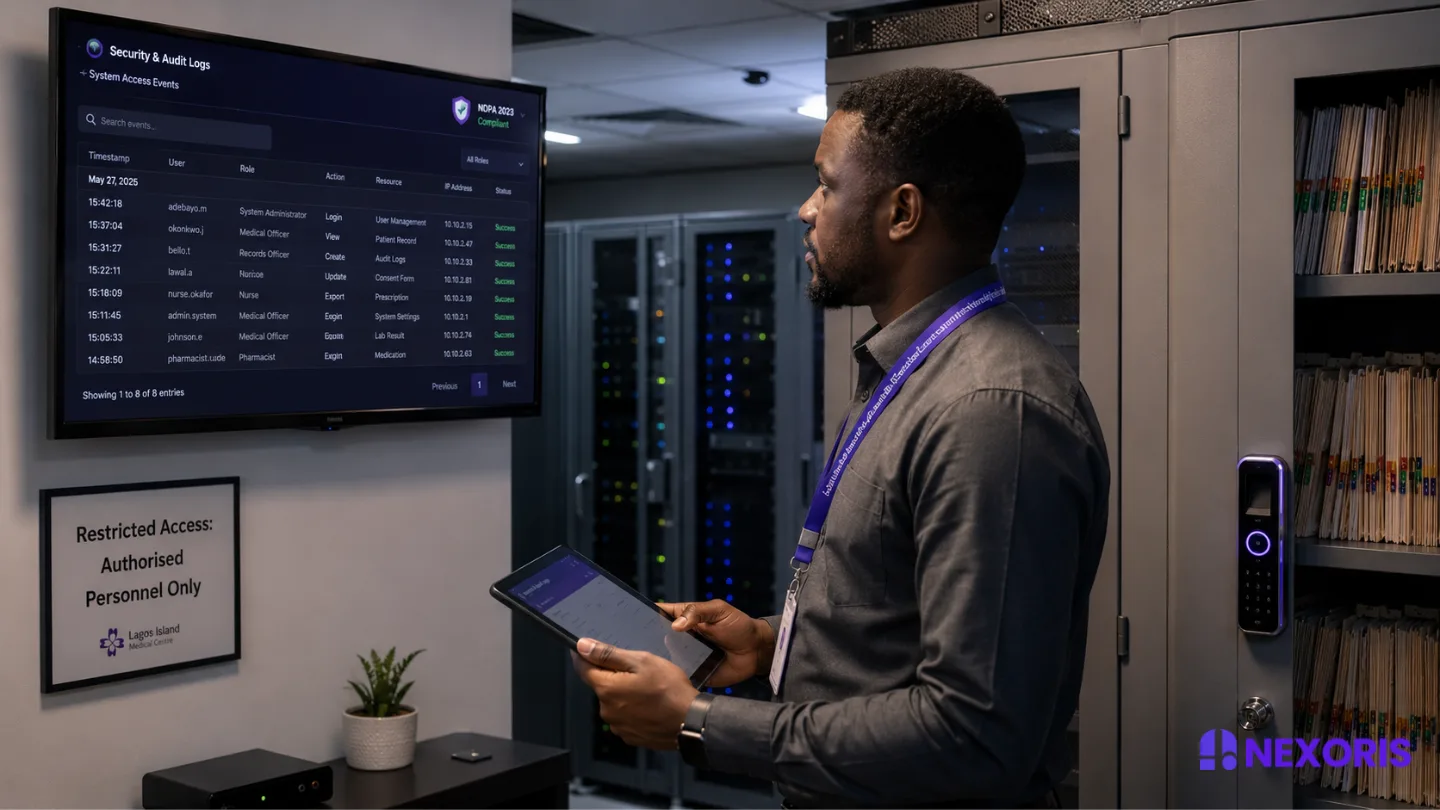
Audit logs and role-based access: Every read, write, and edit on a patient record must be logged with a timestamp and user identity. A receptionist should not be able to view psychiatric notes. A finance officer should not be able to edit clinical entries. The HMS must enforce these boundaries technically, not through policy alone.
Cross-border data transfer: If your cloud provider or backup infrastructure is outside Nigeria, the NDPA requires either an adequacy decision or contractual safeguards. Most major cloud providers offer the necessary data processing agreements. You have to request and sign them.
Breach notification: If patient data is exposed or accessed without authorisation, you have 72 hours from the moment you become aware to notify the NDPC and, depending on severity and risk, the affected individuals.
Building a basic compliance package into the HMS design, including consent capture, retention policy, audit log, role-based access control, and a breach response runbook, costs substantially less at design time than it does after a regulator visit or a complaint.
NHIA, SSHIA, HMO, Lab, and Pharmacy Integrations
An HMS that cannot talk to external systems doubles the workload of your billing and clinical teams. Six integrations appear in most serious Nigerian deployments.
NHIA portal: Direct integration with the National Health Insurance Authority cleans up enrolment checks and claim submission for federally insured patients. Manual portal submission is slow and error-prone at scale.
State Social Health Insurance Agencies: Under the NHIA Act 2022, a significant and growing share of health insurance enrolment is managed at state level by SSHIAs. Your HMS must support the claim formats and portals of the SSHIAs your hospital works with, not just the federal NHIA channel.
HMO claim management: Avon, Hygeia, AIICO Multishield, Reliance, RedCare, and others each have their own claim format, documentation requirements, and submission portals. A serious HMS supports all the major HMOs your hospital actually processes claims with, not a single generic export.
Laboratory integrations: In-house lab analysers should send results directly to the LIS. Reference labs should push results into the EHR automatically. Both eliminate hours of manual data entry per day and reduce the risk of transcription errors on diagnostic results.
Pharmacy and supplier connections: Drug supplier links and NAFDAC product code verification at the point of dispensing reduce dispensing errors and simplify stock reconciliation. NAFDAC product codes should be supported in the pharmacy module.
Payment gateways: Paystack, Flutterwave, Monnify, and Remita for patient payments. Most serious Nigerian HMS platforms support at least two. Patients increasingly expect to pay by card, transfer, or QR code. Cash-only billing is a revenue constraint in 2026.
FHIR, HL7, and Why Interoperability Matters
The HL7 FHIR specification, short for Fast Healthcare Interoperability Resources, is the international standard for moving health data between systems. A Nigerian HMS that supports FHIR can exchange data with other hospitals, reference laboratories, telemedicine providers, public health systems, and government registries without a custom integration built each time.
Three things to ask any vendor directly.
Does the system expose a FHIR API on core resources? Patient, Encounter, Observation, MedicationRequest, DiagnosticReport, and Condition are the minimum set. If the vendor cannot confirm this, you are building in a closed system.
Can it import and export records in standard formats? HL7 v2, FHIR JSON, and CSV at a minimum. Without this, switching vendors in three years means losing access to your own data in a usable form.
Does it support DHIS2 export where required? Public-sector and donor-funded facilities often need to report into the District Health Information System. A system that cannot generate this export creates a separate manual reporting burden.
A vendor who hesitates on all three of these questions is selling you a system you cannot leave and cannot extend cleanly. That is a structural risk regardless of how good the sales presentation is.
Why Your HMS Has to Work Without Internet
A Nigerian hospital cannot afford an HMS that stops working when the power goes off or the ISP drops. Patients keep arriving. Babies keep being delivered. Emergencies keep happening. The system has to keep going.
Three architectural patterns make this work in practice.
Local-first records: The HMS keeps a working copy of the patient record on a hospital server or local workstation. Clinicians read and write to that copy when the internet is unavailable.
Sync-on-connect: When connectivity returns, the system pushes local changes to the central database and pulls in anything that changed elsewhere during the outage. This happens automatically and without manual reconciliation.
Conflict resolution: When two locations edit the same record during an outage, the system applies clear, predefined rules to merge those changes without data loss. Undefined conflict behaviour in a system running across multiple departments is a patient safety issue.
The hospitals that experience the worst HMS failures in Nigeria are almost always the ones that bought a fully cloud-hosted system designed for a market where power and internet are reliable. Demand offline-first architecture from the first technical conversation, not as a feature request after sign-off.
The AI Features Worth Paying For
Based on healthcare projects delivered by Nexoris Technologies between 2025 and 2026, adding AI to an HMS typically adds 10 to 25 percent to the build cost and ₦100,000 to ₦600,000 per month in running cost, depending on which features are active.
Five AI features appear most often in current Nigerian healthcare deployments and deliver measurable outcomes.
AI-assisted clinical documentation: The system transcribes the doctor's voice notes and structures them into the correct EHR fields. In practice, this recovers 30 to 60 minutes per doctor per day that previously went to typing.
Triage and symptom-check chatbot: Patients describe their symptoms via WhatsApp before they arrive. The bot routes them to the right department and flags urgent cases for immediate attention. This reduces front-desk congestion and shortens time-to-care for high-priority patients. For the architecture and cost of building this kind of bot, see our AI chatbot guide for Nigerian businesses.
Predictive readmission alerts: The system identifies patients at elevated risk of readmission based on their clinical history and current vitals, so the discharge team can plan follow-up before the patient leaves.
Claim fraud and leakage detection: The system flags claim submission patterns that fall outside expected ranges, helping the billing team catch errors and reduce unjustified rejections before they become disputes with HMOs.
Appointment optimisation and no-show prediction: The system forecasts which appointments are likely to result in no-shows and allows careful overbooking, lifting utilisation without systematically making patients wait longer than necessary.
The right approach is one feature at a time, chosen because it solves a specific problem you can measure before and after deployment, not because it makes for a strong line item in a board presentation.
Regulators Your HMS Has to Respect
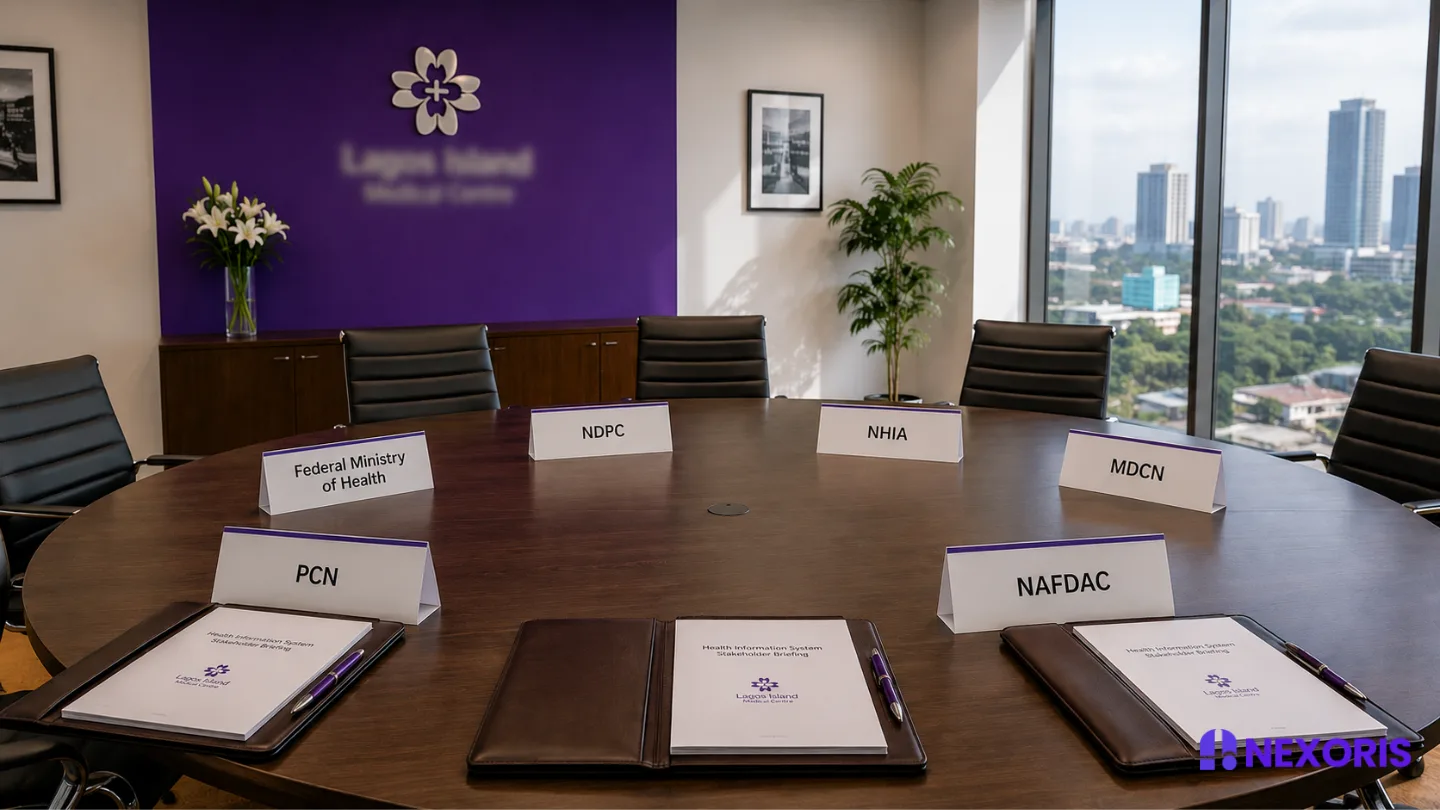
Six bodies set rules that decide what your HMS must do. None of them sells software, but all of them shape the requirements.
Federal Ministry of Health: Owns the National Digital Health Policy and Strategy and the National Telemedicine Guidelines, which govern how remote consultations are conducted and documented.
Nigeria Data Protection Commission: Enforces the NDPA 2023. Patient records are sensitive personal data. Breaches must be reported within 72 hours.
National Health Insurance Authority: Sets claim formats, capitation rates, fee-for-service tariffs, enrolment verification procedures, and provider accreditation requirements.
Medical and Dental Council of Nigeria: Licenses doctors and governs telemedicine practice. All telemedicine consultations must be conducted by MDCN-registered practitioners, and the practitioner's registration number must be attached to the clinical record.
Pharmacists Council of Nigeria: Licenses pharmacists. All dispensing records should carry the dispensing pharmacist's PCN registration number.
NAFDAC: Sets drug registration standards and product codes. The pharmacy module must support NAFDAC product codes at the point of dispensing.
For public-sector hospitals, the Bureau of Public Procurement rules apply in addition to all of the above. This changes the procurement process for an HMS entirely. The selection goes through tendered procurement with technical and financial scoring against published criteria, not a direct vendor conversation.
How Long It Takes, and Where Projects Get Stuck
A small clinic can go live in 4 to 8 weeks. A mid-size hospital typically needs 3 to 6 months. A custom build for a 200-bed multi-specialty hospital usually runs 6 to 12 months. Most projects move through six phases: discovery and scoping (2 to 4 weeks), design and architecture (3 to 6 weeks), build in fortnightly sprints (8 to 24 weeks), data migration (2 to 8 weeks), training and change management (2 to 6 weeks), and phased rollout department by department (2 to 8 weeks).
Understanding why Nigerian HMS projects fail matters more than understanding the phases, because failure is predictable and preventable.
Poor data migration: Paper records arrive in the data migration phase carrying inconsistent dates, missing patient identifiers, and handwriting that two nurses interpret differently. Migration needs to be scoped and resourced as its own project with its own timeline and a dedicated data quality effort.
Treating it as a sprint task at the end of the build is how you end up with a system that goes live with incomplete records and loses the confidence of clinical staff in the first week.
Weak training: Good software handed to staff who received one afternoon of training creates resistance instead of adoption. Doctors who do not understand the system route around it. Pharmacists maintain parallel paper logs as backup. The HMS takes the blame for a rollout problem, and you are back on paper within a month.
Ignored change management: A consultant surgeon or a department head who feels the system was imposed on them without input will not champion it and will not cooperate when something goes wrong. Bring key clinicians into the design process, not just the training sessions.
Single-point internet infrastructure: One ISP, no offline fallback, and a power cut during ward rounds means the hospital is on paper for the duration. Offline-first architecture and at least two independent internet links are not optional enhancements. They are the infrastructure the system needs to rely on in the Nigerian environment.
Vendor lock-in: A contract with no exit clause, no FHIR or HL7 export provision, and no defined data portability window means you do not own your hospital's data in any practical sense. You are renting access to it under the terms the vendor sets.
Resolve data ownership and portability in the contract before signing, not after you have been running on the system for three years.
How to Choose an HMS Vendor in Nigeria
Send every provider these 14 questions before you sign a contract. The quality and confidence of the answers tells you everything you need to know about whether this is the right partner.
Does the system work fully offline during power outages and internet failures, and can you demonstrate this in a live test?
Does it integrate directly with NHIA, the SSHIAs we work with, and the specific HMOs we serve, confirmed in writing?
What is your written position on NDPA 2023 compliance, including your breach notification process?
Does the system support multiple sites under one database with site-level access controls?
Is the interface genuinely mobile-first and tablet-friendly for clinicians moving between wards?
Does the system expose a FHIR API on core resources, and can we export our data in HL7 v2, FHIR JSON, and CSV formats?
What does the training package include, and how many training sessions are covered before additional cost applies?
Where is your local support team based, and what are your written response time commitments?
Is the quote fully itemised in naira, with VAT stated separately and any dollar-denominated third-party tools listed apart from the core cost?
What is the exit process if we want to move to a different system in three years, and in what data formats will our records be exported?
Can you run a demo using our actual clinical and billing workflows, not your generic product walkthrough?
Can you provide contact details for three Nigerian hospitals of comparable size that you have implemented in the last 18 months, reachable by phone?
Are full audit logs of every read, write, and edit on a patient record available for compliance inspection?
Does the pharmacy module support NAFDAC product codes, and does the clinical module support ICD-10 coding?
A serious provider answers all 14 in writing without hesitation. To run a structured evaluation across multiple vendors, our vendor selection framework for Nigerian software buyers gives you the scoring sheet and contract clauses to insist on.
Final Word: The One Decision That Matters Most
The HMS market in Nigeria has grown crowded enough that the hard part is no longer finding a vendor. It is recognising which decision changes the most. That decision is not which platform to buy. It is whether you are buying software at all, or buying a long-term partnership with a team that will keep your hospital running through five years of regulatory change, infrastructure outages, and clinical evolution.
A SaaS subscription, a custom build, and an open-source deployment are not just three pricing options. They are three different relationships. SaaS makes the vendor responsible for the system and you responsible for the workflow. Custom makes you responsible for both, with a partner alongside. Open source makes you responsible for everything, in exchange for full control. Hospitals fail with HMS rollouts more often because they pick the wrong relationship than because they pick the wrong product.
Whichever path you take, treat the next 12 months as the year your hospital learns to run on software. Budget for it. Train for it. Protect senior clinical buy-in for it. And measure it the way you would measure a clinical programme, with weekly numbers, named accountability, and a willingness to course-correct early.
If you would value an outside read on which path fits your hospital before you commit, request a healthcare technology consultation. We will return a written assessment within five business days, with no obligation to engage Nexoris Technologies for the build.
How We Wrote This Article
The Naira cost ranges and deployment patterns in this article come from healthcare projects delivered by Nexoris Technologies for Nigerian clients between 2025 and 2026.
NHIA reform figures reflect the February 2025 announcement by NHIA Director-General Dr. Kelechi Ohiri at the NHIA-HMO Standing Committee Meeting in Abuja, as reported by Nairametrics, BusinessDay, Vanguard, Blueprint, and Guardian, and the April 2025 implementation date confirmed by Nairametrics in a subsequent report on HMO premium adjustments.
Market size data is sourced from Federal Ministry of Health figures and the NHIA provider registry. Regulatory references come from the National Health Insurance Authority Act 2022, the Nigeria Data Protection Act 2023 and the General Application and Implementation Directive issued by the NDPC, the National Digital Health Policy from the Federal Ministry of Health, the National Telemedicine Guidelines from the FMOH and MDCN, the HL7 FHIR R4 specification, and the PCN and NAFDAC regulatory frameworks.
The OpenMRS reference implementation and ISO/IEC 27001 are also referenced where applicable.
All public sources were verified at the time of writing. Where figures come from Nexoris Technologies' own project data, this is stated explicitly in the article.
Source References
National Health Insurance Authority. NHIA Act 2022, capitation and fee-for-service guidance (nhia.gov.ng)
Nairametrics. "NHIA increases capitation fees by 93%, fee-for-service by 378%, effective April 2025", February 2025 (nairametrics.com)
BusinessDay. "NHIA hikes capitation by 93%, implements 378% service fee to boost healthcare", February 2025 (businessday.ng)
Vanguard. "NHIA raises capitation fees by 93%", February 2025 (vanguardngr.com)
Nairametrics. "Rising drug prices force sharp increases in health insurance premiums across Nigeria", November 2025 (nairametrics.com)
Nigeria Data Protection Commission. NDPA 2023 and General Application and Implementation Directive (ndpc.gov.ng)
Federal Ministry of Health Nigeria. National Digital Health Policy and Strategy, National Telemedicine Guidelines (health.gov.ng)
Medical and Dental Council of Nigeria. Practitioner registration and telemedicine guidance (mdcn.gov.ng)
Pharmacists Council of Nigeria. Practitioner registration (pcn.gov.ng)
NAFDAC. Drug registration and product code system (nafdac.gov.ng)
Bureau of Public Procurement. Public Procurement Act 2007 and current procurement circulars (bpp.gov.ng)
OpenMRS. Reference implementation documentation (openmrs.org) ISO/IEC 27001. Information security management standard
Nexoris Technologies. Internal delivery data from healthcare projects, 2025 to 2026 (nexoristech.com)
Share this article
Common questions
What is Hospital Management System in Nigeria? +
Custom build: ₦4M to ₦25M. Annual maintenance: 15 to 20% of build cost.
How does Nexoris Technologies approach Hospital Management System in Nigeria? +
Custom build: ₦4M to ₦25M.
What are the benefits of Hospital Management System in Nigeria? +
Annual maintenance: 15 to 20% of build cost.
Who is Hospital Management System in Nigeria for? +
The costs and deployment patterns here come from healthcare projects delivered by Nexoris Technologies for Nigerian clients between 2025 and 2026.
How do I get started with Hospital Management System in Nigeria? +
Tell Nexoris Technologies about your goals and we will come back with a clear plan and honest numbers, with no obligation. You can reach us from the contact page.
Written by
Chinedu Nwogu
Chinedu is a founder & ceo at Nexoris Technologies, writing about Founder & CEO of Nexoris Technologies | SEO, GEO & AEO Specialist | Software & Digital Product Expert. Chinedu turns hard ideas into clear, useful reading and cares about getting the details right.
Chinedu is a fact-checker at Nexoris Technologies, writing about Founder & CEO of Nexoris Technologies | SEO, GEO & AEO Specialist | Software & Digital Product Expert. Chinedu turns hard ideas into clear, useful reading and cares about getting the details right.
Decide whether to invest in pre-built systems like SAP or a custom solution built by Nexoris Technologies. This guide compares setup costs ranging from 500,000 to 40 million Naira to help you choose the right path for your business growth.




 Chinedu Nwogu