ERP Software in Nigeria 2026: Custom vs Off-the-Shelf, Cost, and How to Choose
Decide whether to invest in pre-built systems like SAP or a custom solution built by Nexoris Technologies. This guide compares setup costs ranging from 500,000 to 40 million Naira to help you choose the right path for your business growth.
ERP software in Nigeria falls into two categories: off-the-shelf systems such as Sage, SAP, Oracle NetSuite, Microsoft Dynamics, Odoo, and ERPNext , and custom-built ERP systems designed around a specific business.
Off-the-shelf systems cost less upfront and deploy faster.
Custom systems cost more at the start but fit local workflows, scale without licence inflation, and avoid the dollar-priced subscription fees that hurt Nigerian budgets when the Naira weakens.
What is ERP software, and why does it matter for Nigerian businesses?
ERP (Enterprise Resource Planning) software is a system that connects the main parts of a business, including accounting, inventory, sales, HR, and operations, so they share the same data and follow the same rules.
ERP software in Nigeria falls into two categories: off-the-shelf systems such as Sage, SAP, Oracle NetSuite, Microsoft Dynamics, Odoo, and ERPNext, and custom-built ERP systems designed around a specific business. Off-the-shelf systems cost less upfront and deploy faster. Custom systems cost more at the start but fit local workflows, scale without licence inflation, and avoid the dollar-priced subscription fees that hurt Nigerian budgets when the Naira weakens.
What is ERP software, and why does it matter for Nigerian businesses?
ERP (Enterprise Resource Planning) software is a system that connects the main parts of a business, including accounting, inventory, sales, HR, and operations, so they share the same data and follow the same rules. Instead of using separate tools that never quite line up, the business runs from one source of truth.
For Nigerian businesses, this matters for three reasons.
Manual processes break at scale. Spreadsheets and WhatsApp work when a business is small. Once transaction volume rises, errors and delays multiply. ERP brings structure to operations that have outgrown manual control.
Disconnected tools create data silos. Most growing companies use one tool for accounting, another for inventory, another for HR, and a fourth for sales. Each holds part of the truth, and reconciling them takes hours. ERP removes the duplication.
Compliance and reporting are getting stricter. NRS, NDPC, and sector-specific regulators expect accurate records. ERP makes it easier to produce reports that match across departments.
What are the types of ERP software available in Nigeria?
There are two broad categories.
Off-the-shelf ERP is pre-built software you license from a vendor. You configure it, train your team, and use it. Examples used in Nigeria include Sage 300, SAP Business One, Oracle NetSuite, Microsoft Dynamics 365 Business Central, Odoo, and ERPNext.
Custom ERP is software designed and built for one business. The features, workflows, and reports match exactly how that business operates. Custom ERP is usually delivered by a local development partner, deployed on cloud or on-premise, and owned outright by the business.
A third path, hybrid ERP, combines off-the-shelf modules (often Odoo or ERPNext, both open-source) with custom-built extensions. This is increasingly common for mid-sized Nigerian businesses that want speed plus flexibility.
Custom ERP vs off-the-shelf ERP: which is right for your business?
Here is a side-by-side comparison.
Factor
Off-the-shelf ERP
Custom ERP
Upfront cost
Lower (₦500k to ₦5M setup)
Higher (₦5M to ₦40M+)
Deployment time
4 to 12 weeks
3 to 9 months
Monthly cost
Per-user subscription, often in USD
None, or local hosting only
Fit to your workflow
Forces you to adapt
Built around how you work
Scalability
Limited by licence tiers
Designed to scale with the business
Updates
Vendor pushes them
You decide when
Local support
Depends on partner availability
Direct line to the developer
Data ownership
Vendor's servers, vendor's terms
You own the system and the data
Currency exposure
High (most are USD-priced)
Low (Naira-priced)
Best for
Standard processes, fast deployment, smaller teams
The honest summary is this. Off-the-shelf ERP is right when your business is small to mid-sized, your processes are standard, and you need something working in two months. Custom ERP is right when your processes are genuinely different from the average, you are growing fast, you operate across multiple branches or product lines, or you want to stop paying subscription fees that rise every time the Naira weakens.
These are the systems Nigerian businesses most commonly evaluate.
Sage (Sage 300, Sage 50cloud, Sage X3). Long-established in Nigeria with strong local support partners. Good for SMEs and mid-market companies in finance, distribution, and manufacturing.
SAP Business One. Designed for SMEs that want a globally proven system. Implementation costs are higher than Sage but the feature set is deeper.
Oracle NetSuite. Cloud-first ERP popular with funded startups, fintech, and businesses with international operations. USD-priced.
Microsoft Dynamics 365 Business Central. Strong fit for businesses already using Microsoft 365. Per-user monthly subscription model.
Odoo. Open-source, modular, and increasingly popular among Nigerian SMEs because of its low entry cost. Implementation is usually handled by a local Odoo partner.
ERPNext. Free and open-source, with no licensing fees. Good for businesses with technical capacity in-house or a strong local implementation partner.
Custom ERP. Built by a local development team to match a specific business. Highest fit, no licence fees, longer to deploy.
How much does ERP software cost in Nigeria in 2026?
ERP cost depends on the type of system, the size of the business, and the number of modules. Here are realistic 2026 ranges in Naira.
ERP type
Setup or development cost
Annual running cost
Odoo or ERPNext (with local partner)
₦1,500,000 to ₦5,000,000
₦600,000 to ₦3,000,000
Sage 300
₦3,000,000 to ₦8,000,000
₦1,500,000 to ₦4,000,000
SAP Business One
₦8,000,000 to ₦20,000,000
₦3,000,000 to ₦8,000,000
Oracle NetSuite
₦10,000,000 to ₦25,000,000
₦4,000,000 to ₦12,000,000+
Microsoft Dynamics 365 BC
₦5,000,000 to ₦15,000,000
₦2,500,000 to ₦7,000,000
Custom ERP (built by Nigerian team)
₦5,000,000 to ₦40,000,000+
₦600,000 to ₦3,000,000 (hosting and support)
A few things to note. First, most off-the-shelf ERP subscriptions are billed in dollars or pegged to the dollar, so the Naira figures above will rise if the exchange rate moves. Second, implementation cost is rarely included in the licence fee, so add 30 to 100 percent of the licence cost for setup, training, and data migration.
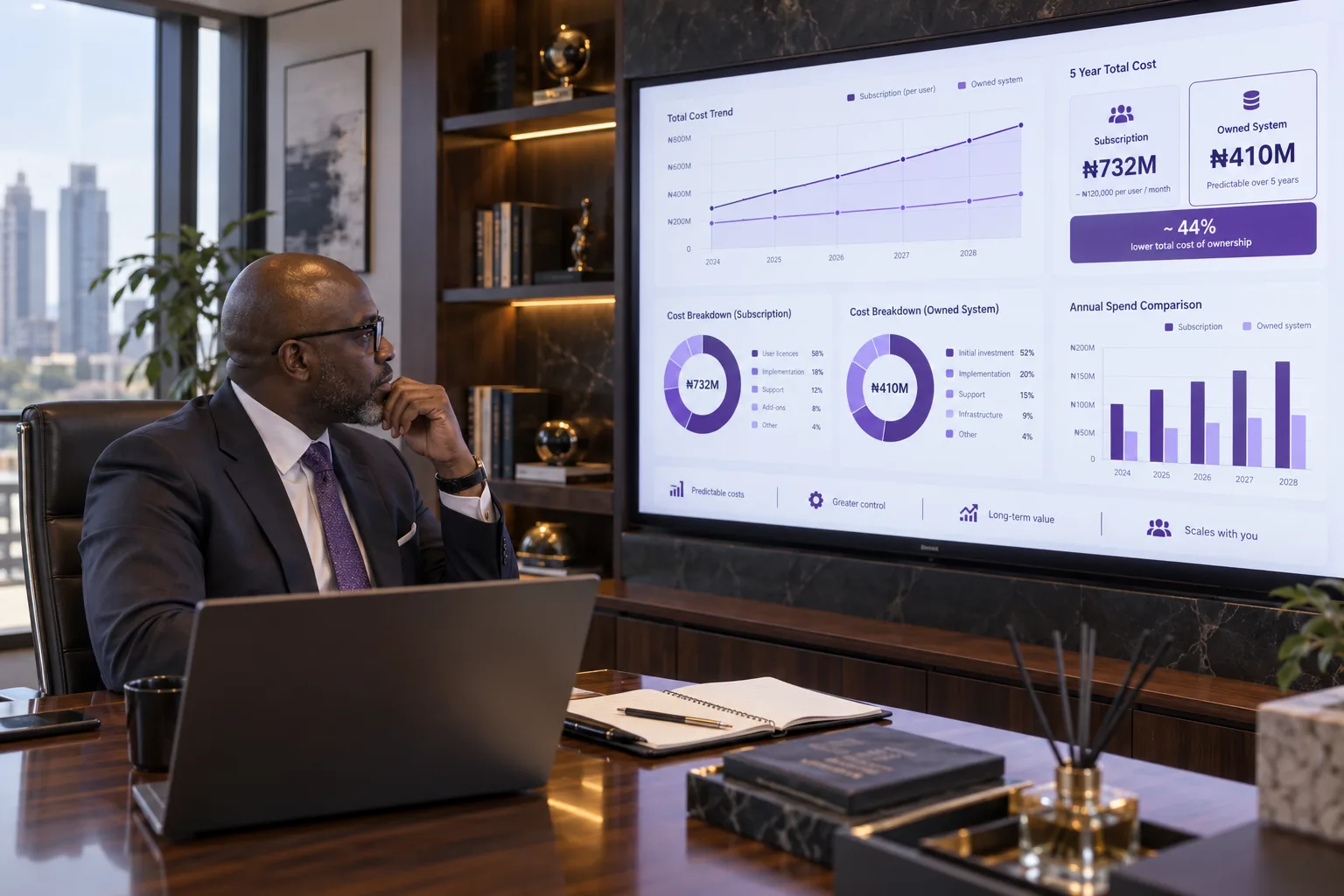
Third, custom ERP has a higher upfront cost but no per-user fees, which usually makes it cheaper over a 3 to 5 year horizon for businesses with 30 or more users.
What does custom ERP solve that off-the-shelf cannot?
Custom ERP exists because real businesses are not standard. Here is what it does better.
It matches local workflows. Approval structures, payment flows, and reporting requirements in Nigeria often differ from what international ERP vendors assume. Custom systems are designed around your real process, not a Western template.
It removes unused features. Off-the-shelf systems bundle hundreds of features, most of which you will never use. You pay for them anyway. Custom systems include only what your business needs.
It ends licence inflation. Per-user subscriptions sound affordable until your team doubles. Custom systems do not charge you more for adding the next 50 employees.
It survives currency changes. Hosting and support for a custom system can be paid entirely in Naira. Off-the-shelf renewals usually rise with the dollar.
It integrates cleanly with your existing tools. Whether you use Paystack, Flutterwave, internal logistics platforms, or legacy databases, a custom ERP can be designed to talk to them from day one.
It evolves with you. When your business changes, the system changes. Off-the-shelf systems force you to wait for the vendor's next release or pay for expensive customisations that break on every upgrade.
When does custom ERP make sense for a Nigerian business?
Custom ERP is the right choice when several of the following are true.
You have more than 20 employees and are growing. You operate across multiple branches, product lines, or business units. Your processes have meaningful differences from the industry average. You are paying for several disconnected tools that do not talk to each other.
Your existing ERP forces frequent manual workarounds. You are tired of subscription fees rising every year. You need to integrate with internal or industry-specific systems. You want to own the system rather than rent it.
If two or fewer of these apply, an off-the-shelf system is probably the better starting point. If four or more apply, custom ERP is likely a better long-term investment.
Want to know which path fits your business? Request a free 30-minute consultation and we will walk through your operations and recommend the right approach, including off-the-shelf options if that is the better fit.
How is custom ERP built? A 5-step implementation process
Done well, custom ERP follows a clear path.
Step 1: Discovery and process mapping (2 to 4 weeks). The development team studies how your business actually runs today. This includes shadowing teams, mapping workflows, and identifying pain points. Skipping this step is the most common reason custom ERP projects fail.
Step 2: Design and prioritisation (2 to 3 weeks). Workflows, screens, and reports are designed and reviewed with the people who will use them. Modules are prioritised so the most valuable ones launch first.
Step 3: Phased development (3 to 6 months for first phase). The system is built in sprints, with working versions released every 2 to 4 weeks. Phase one usually covers core finance, inventory, or operations, depending on what is most painful to manage manually.
Step 4: Migration, training, and go-live (2 to 4 weeks). Existing data is cleaned and moved into the new system. Staff are trained in their actual roles, not just the software. The system goes live in stages rather than all at once.
Step 5: Iteration and support (ongoing). Real users find real problems. The first three months after go-live are when the system gets refined into its final form. After that, new modules and integrations are added as the business grows.
This is the process Nexoris Technologies follows on every custom ERP build, and it is why our projects launch on time and stay in active use long after handover.
How Nexoris builds custom ERP for Nigerian businesses
Nexoris Technologies is a Lagos-based digital studio. We build custom ERP systems for Nigerian businesses across fintech, retail, healthcare, education, and professional services. Every project starts with discovery, not with a price quote, because no two operations are the same.
Our ERP builds run on Nexoris Cloud, which means hosting is priced in Naira, backed up daily, and monitored continuously. Clients own the source code at handover. There are no per-user licence fees and no surprise renewals tied to the exchange rate.
If you are weighing custom ERP against an off-the-shelf system, we will tell you when off-the-shelf is the better fit. The goal is to solve your operational problem, not to sell you software you do not need.
Ready to scope your project? Request a proposal or book a technical audit of your current systems.
Sources and references
Nexoris Technologies internal project data, 2025 to 2026
Sage, SAP, Oracle, Microsoft Dynamics public pricing pages, 2026
Odoo and ERPNext community implementation pricing benchmarks
What is the main difference between off-the-shelf and custom ERP software? +
Off-the-shelf software is pre-built and licensed from a vendor, which makes it faster to deploy and cheaper to start. However, it forces your business to adapt to its existing workflows. Custom ERP software is built specifically for your business processes, meaning it fits your operations exactly, allows you to avoid dollar-based subscription fees, and scales without extra per-user costs.
How long does it typically take to deploy an ERP system in Nigeria? +
Deployment times depend on the complexity of the system. Off-the-shelf ERP solutions generally take between 4 to 12 weeks to set up. Custom-built ERP systems require a longer development period, typically ranging from 3 to 9 months, as they are designed from the ground up to match your specific business requirements.
What are the common costs associated with implementing ERP software? +
Costs vary based on the type of system and business size. Off-the-shelf setup costs range from ₦500,000 to ₦5,000,000, while custom solutions can range from ₦5,000,000 to over ₦40,000,000. Keep in mind that implementation costs, which cover training and data migration, are often separate from the license fee and can add 30 to 100 percent to your initial budget.
Which type of ERP is better for a growing Nigerian business? +
If your business has standard processes and needs a quick solution, an off-the-shelf system is often the best fit. However, if your workflows are unique, you are growing rapidly, or you operate across multiple branches, a custom ERP from Nexoris Technologies or another local development partner may be better. Custom systems are often more cost-effective over a 3 to 5 year period for companies with 30 or more users because they eliminate per-user subscription fees.
Why do many Nigerian businesses prefer custom ERP over international options? +
Custom ERP systems are preferred because they avoid the volatility of dollar-priced subscription fees, which can become expensive as the Naira weakens. Additionally, they allow businesses to avoid paying for unused features, provide full ownership of data, and can be built to match specific local approval structures and payment flows that international templates might not support.
What happens to my software costs if my team grows? +
With off-the-shelf software, your costs typically rise as your team grows because these systems usually charge per-user subscription fees. With a custom ERP system, you do not pay extra fees for adding more employees, which makes it a more predictable and scalable option for businesses that expect to expand their headcount significantly.
Written by
Chinedu Nwogu
Chinedu Nwogu is the Founder and CEO of Nexoris Technologies with 7 years of expertise in SEO, GEO, and AEO, as well as software and digital products. His background in developing digital products informs his analysis of the trade-offs between off-the-shelf and custom-built ERP systems for businesses navigating local operational and economic challenges.
Chinedu Nwogu is a fact-checker with 7 years of experience as the Founder and CEO of Nexoris Technologies and as an SEO, GEO, and AEO specialist. His background in software and digital products informs his analysis of the technical and financial trade-offs between off-the-shelf and custom-built enterprise resource planning systems for the Nigerian market.
Key Facts at a Glance SaaS HMS: ₦150K to ₦5M+ per year. Custom build: ₦4M to ₦25M. Annual maintenance: 15 to 20% of build cost. Payback period: 18 to 30 months.
Use this breakdown to estimate your budget based on project complexity, ranging from ₦1.8 million for simple tools to over ₦65 million for enterprise systems.


 Chinedu Nwogu