Custom Software Development Cost in Nigeria in 2026: ₦1.8M to ₦65M+
Use this breakdown to estimate your budget based on project complexity, ranging from ₦1.8 million for simple tools to over ₦65 million for enterprise systems.
Custom software development in Nigeria ranges from ₦1.8 million for simple tools to over ₦65 million for enterprise platforms.
Project costs are driven by complexity rather than just the type of software being built.
You should budget an additional 15% to 25% of the development cost annually for ongoing maintenance.
Nexoris Technologies suggests that clear project requirements are necessary to get an accurate quote.
Remember to account for extra expenses like hosting, third-party services, and VAT beyond the initial development fee.
Key facts at a glance
Budget question
Indicative 2026 figure
Focused internal tool or web-based MVP
₦1.8M to ₦6M
Business web application
₦6M to ₦22M
Multi-module system or SaaS platform
₦22M to ₦65M
Large enterprise platform
₦65M+
Annual maintenance planning allowance
Around 15% to 25% of the original development cost, depending on the agreement
Standard VAT rate on taxable services
7.5%, where chargeable
Typical delivery period
Around 6 weeks for a small, clearly defined tool to 12 months or more for a complex system
The pricing in this article is for software built to an agreed scope, including the development work needed to make it usable. It is not a price list for template-based websites or a promise that any project described as an MVP will fit the lowest band. Unless a proposal says otherwise, allow separately for ongoing hosting, usage-based services, maintenance, new features and applicable VAT.
How much does custom software development cost in Nigeria in 2026?
Custom software can cost from about ₦1.8 million for a small internal tool to more than ₦65 million for a large, demanding platform. The main question is how much work sits behind the features you want: the business rules, different types of users, integrations, data handling, testing and support that make the system dependable.
Take two businesses asking for an inventory system. A small shop may need staff to record stock received and sold, then view a daily report. A distributor with several branches may need purchase approvals, warehouse transfers, barcode scanning, customer orders, accounting integration and stock updates that continue when the internet drops. Both projects are called inventory systems, but they would not receive the same quote.
That is why a price range is a starting point. A written scope is what turns it into a usable estimate.
Custom software development cost by project size
Project size
Indicative development budget
What it might include
Planning timeline
Common reasons the cost rises
Focused internal tool or MVP
₦1.8M to ₦6M
One main workflow, a limited number of screens and a simple admin area. For example, an internal approval or booking tool.
6 to 12 weeks
Payments, complex user permissions, data migration or several integrations
Business web application
₦6M to ₦22M
Customer and staff accounts, a database, dashboards, reports and a few integrations. For example, a service booking or stock management platform.
3 to 6 months
Offline features, more demanding workflows, mobile apps or specialised security
Multi-module system or SaaS platform
₦22M to ₦65M
Several connected business functions, detailed permissions, reporting, subscriptions or multiple client organisations.
5 to 10 months
Multi-tenancy, historical data migration, high transaction volumes or complex billing
Large enterprise or heavily regulated platform
₦65M+
Business-critical systems with extensive integrations, availability, security and audit requirements.
8 to 18 months or longer
Legacy systems, independent audits, large migrations and phased rollout across locations
These timelines are estimates for planning. A development team can only commit to a delivery schedule after agreeing the requirements, dependencies and approval process.
Focused internal tool or MVP: ₦1.8M to ₦6M
This range may be suitable when one recurring problem needs fixing. Perhaps staff complete the same approval form several times, or a business wants to replace one shared spreadsheet with a tool that controls who can view and edit records.
A startup might also use this budget for a small MVP that tests one important idea with real users. An MVP should be limited in scope, but it still needs to work properly. Calling a product an MVP does not make payment integration, several user roles and separate mobile apps inexpensive.
Business web application: ₦6M to ₦22M
This is often the relevant range for a system used by customers and staff. A booking platform, for example, may let customers choose an appointment, staff manage availability and managers review payments and reports.
The development work goes beyond designing those screens. Someone has to build the rules that prevent double bookings, make sure permissions are correct and decide what happens when a payment is interrupted. Those details affect the quote.
Multi-module system or SaaS platform: ₦22M to ₦65M
Projects reach this range when several functions need to work together. A business may want purchasing, inventory, sales and finance to use the same data. A SaaS company may need to serve several customer organisations while keeping their accounts and records separate.
That can mean more involved database design, subscriptions, reporting, access controls, audit logs and external integrations. A small SaaS MVP can still cost less than this range. The figures here refer to a more developed product with several working parts.
Large enterprise or heavily regulated platform: ₦65M+
A large platform may need to process substantial volumes of transactions, connect to older systems, serve several departments or support strict availability and security requirements. Healthcare and financial services projects may also need extra controls for sensitive information and regulated processes.
Industry alone does not determine the cost. A small tool for a hospital does not automatically belong in the ₦65 million category. The scope, risks and technical requirements determine where the project sits.
Example: What could a ₦10 million custom software project include?
Imagine a distribution company in Lagos that manages orders, stock and monthly reports through spreadsheets and WhatsApp. Staff spend time checking different records before they can confirm whether an item is available or an order has been fulfilled.
The company wants one browser-based system for office and warehouse employees. Its first release will include staff login, customer and product records, stock received and dispatched, order status, management reports, an admin area and one straightforward external integration.
It will not include separate Android and iPhone apps, advanced delivery-route planning, a complete accounting system or a rollout to warehouses across the country. Those would need to be priced separately if the company decides to add them.
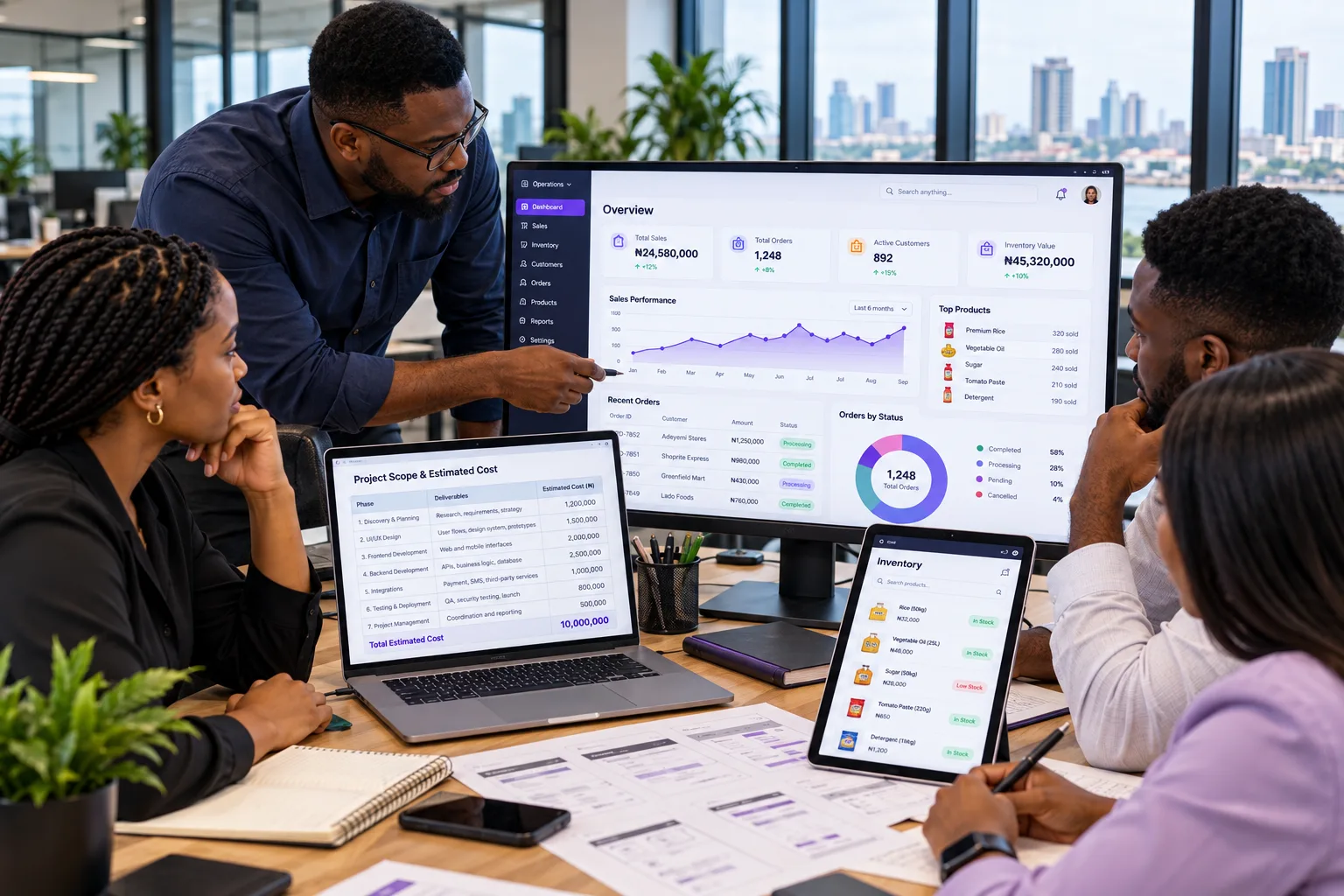
Here is an illustrative breakdown of a ₦10 million development budget. It is an example to show how a quote may be structured, not a completed Nexoris client project or an offer at these prices.
Work
Illustrative amount
Discovery and requirements
₦900,000
User experience and interface design
₦1,100,000
Frontend development
₦2,000,000
Backend, database and business rules
₦2,900,000
One supported external integration
₦900,000
Functional, device and security testing
₦1,200,000
Deployment and launch setup
₦500,000
Documentation, handover and initial staff training
₦500,000
Total development budget
₦10,000,000
Now suppose the company adds offline stock updates at a second warehouse, a connection to its accounting software and a mobile app for delivery staff. The estimate would change because the first release has become a larger project.
If the ₦10 million amount is exclusive of VAT and 7.5% VAT is chargeable, VAT adds ₦750,000. The development invoice would then total ₦10,750,000. The company would still need to budget for hosting, ongoing support and any third-party usage charges not included in the contract.
What increases custom software development costs in Nigeria?
A project usually becomes more expensive because it has more work to do, not because a developer chooses a complicated name for it. These are the requirements that are worth discussing early.
Integrations with payment, banking and other systems
Your software may need to exchange information with Paystack, Flutterwave, an accounting package, an SMS provider, WhatsApp Business Platform or a logistics company. Each connection needs setup, testing, error handling and, in some cases, approval from the provider.
A standard payment gateway integration is not the same as connecting directly to a bank's systems. The second may have additional access, security and testing requirements. Ask what your software needs to send and receive, and whether the outside service charges setup or usage fees.
Reliable use when the internet is poor
A field team might need to record a visit when there is no connection. Warehouse staff may have to continue receiving stock during an outage and sync their records later.
Offline operation can require local storage, safe syncing and rules for resolving conflicting changes. The development team also needs to test what happens when a connection drops halfway through an action. This should be discussed at the start rather than requested shortly before launch.
Migrating data from an existing system
If your new software is replacing spreadsheets or an older platform, you may need customer records, products, balances and past transactions moved across.
That work can involve removing duplicates, correcting mistakes, matching fields and checking the imported records. A system with only a few new screens may still need a large amount of migration work.
Security, permissions and availability
Software used for payroll, healthcare, payments or other sensitive work may need detailed access controls, activity logs, encryption, backups, monitoring and more thorough testing. Some organisations may also need an independent security assessment before the system goes live.
Ask the provider to explain the controls included in the quote. The word “secure” on its own is not a specification.
AI features, when there is a clear use for them
A chatbot that answers questions from approved website content is quite different from an AI assistant that checks customer records, creates orders or changes information in another system. The second needs deeper integration, tighter permissions and more testing. Developing a custom model is another kind of project again.
There is no sensible flat percentage that covers the cost of adding AI to every software product. Define what the feature should do, what data it can use and how you will judge whether it works. Then price the development and any ongoing model or API usage.
Not every software project needs AI. A better process, a reliable dashboard or a simple connection between existing tools may solve the problem without it.
Does your software need to support Nigerian e-invoicing and data protection rules?
These requirements are especially relevant when a planned platform will issue invoices, store customer information or handle sensitive business data. They can affect the database, integrations and operating processes, so they are easier to plan for before development begins.
NRS e-invoicing: Check your business category and dates
The Nigeria Revenue Service (NRS), formerly the Federal Inland Revenue Service (FIRS), is rolling out its national e-invoicing and Electronic Fiscal System in phases. The system is also known as the Merchant Buyer Solution.
The timetable published in February 2026 divides taxpayers by annual turnover:
Taxpayer category
Annual turnover
Scheduled go-live
Scheduled compliance enforcement
Large taxpayers
Above ₦5 billion
November 2025 rollout
2026, subject to later NRS notices
Medium taxpayers
₦1 billion to ₦5 billion
1 July 2026
January to March 2027
Emerging taxpayers
Below ₦1 billion
1 July 2027
January to March 2028
This is the published phased timetable, not a guarantee that every date will remain unchanged. In July 2026, the NRS also directed large taxpayers to complete adoption by 31 July 2026. You should confirm the latest notices and your business's obligations with the NRS and your tax adviser before commissioning an invoicing system.
A business covered by the rules may need its accounting or ERP software to prepare invoice data in the required format, send it through an appropriate integration and support invoice validation and reporting. The NRS has published separate guidance for System Integrators and Access Point Providers. A business buying software should not assume it has to register as one of these service providers simply to use the system.
If the platform you want to build will issue invoices, ask the developer how the integration will work, who is responsible for provider onboarding, what approvals are needed and who will maintain it when the requirements change.
Nigeria Data Protection Act 2023: Plan how personal data will be handled
If your software processes personal data, the Nigeria Data Protection Act 2023 may affect how the system collects, uses, stores and shares that information. The design should allow for an appropriate lawful basis for processing, consent where it is required, access restrictions, data minimisation and suitable security measures.
A customer database and a hospital records platform do not have the same risks. Before development, decide what information the system really needs, who can see it, how long it must be retained and how the business will respond to valid requests to access or correct personal data.
A software company can build technical safeguards, but those safeguards do not by themselves certify that your organisation complies with every legal requirement. Seek appropriate legal or regulatory advice for your particular use case.
How much do different types of custom software cost?
The price bands above cover a broad range of products. Your choice of platform and business model will help determine which guide is most relevant.
Web applications and internal business systems
These include customer portals, booking tools, dashboards, staff systems and custom platforms accessed through a browser. Most fall within the business web application bands when they have several workflows and user roles. A simple company website is a different type of project. See our website cost guide for Nigeria if that is what you need.
Mobile applications
A mobile product may need Android, iOS or both. It may also need an admin dashboard, a backend, push notifications and testing across real devices. Building for two operating systems can change the scope, although a suitable cross-platform approach may reduce duplicated work. Our mobile app development cost guide goes into those costs in more detail.
E-commerce platforms and marketplaces
A template-based online shop, a custom e-commerce platform and a multi-vendor marketplace should not be treated as the same project. A marketplace may add seller accounts, commission rules, order tracking, delivery integrations, disputes and settlement processes. Read more about our retail and e-commerce software services.
ERP and business management software
An ERP system can connect inventory, procurement, finance, HR or operations in one place. Price depends on the modules included, approval rules, reporting, existing data and number of locations. Our guide to custom ERP software in Nigeria also explains when an off-the-shelf product may be worth considering.
AI chatbots and virtual assistants
A chatbot may be a small addition to a website or a larger product connected to company records and workflows. A subscription chatbot is also a different purchase from custom development. See our AI chatbot guide for Nigerian businesses for a more focused comparison of build and running costs.
What can be missing from a software development quote?
Before accepting a quote, ask for a clear breakdown of what the price includes. The following items are not always treated in the same way by every supplier.
Cost or service
What to confirm
Discovery and requirements
Will the team document the requirements and agree on what the first release includes?
Design
Are user flows, interface designs and review rounds included?
Data migration
Who will clean, import and check existing records?
Testing
Which browsers, devices, workflows and security checks will be covered?
Integrations
Does the price cover development, provider setup and required approvals?
Hosting and infrastructure
Who pays for servers, storage, backups, monitoring and domains?
Third-party services
Who pays for SMS, WhatsApp, maps, payment processing or AI usage?
Training and handover
Will staff training, documentation, credentials and source files be provided?
Maintenance
What support is included after launch, and for how long?
Future features
How will work outside the approved scope be quoted?
Taxes
Is the stated amount inclusive or exclusive of VAT, where chargeable?
You should be able to compare two quotes against the same scope and exclusions. A low price may be perfectly reasonable for a smaller first release. The problem is discovering later that important work was not included.
How much does it cost to maintain custom software after launch?
For early budgeting, you can allow around 15% to 25% of the original development cost each year for maintenance and technical support. This is an estimate, not a standard price that every provider charges. Support hours, the size of the system, response times and any required uptime commitments affect the real figure.
For a ₦6 million business application, that allowance looks like this:
Planning scenario
Annual maintenance budget
15% of development cost
₦900,000
25% of development cost
₦1,500,000
A maintenance agreement might cover bug fixes, security patches, dependency updates, monitoring and backup checks. It may or may not include hosting. New modules, major design changes, extra infrastructure and usage-based services are usually separate unless the contract says otherwise.
Read our Managed Technology Operations page if you want a defined support arrangement for software you already use or plan to build.
How do software companies price projects and collect payments?
A fixed-price contract sets a total price for an agreed scope. It works well when the requirements, deliverables and acceptance criteria are clear. If you ask for additional features after approval, the price or timeline may need to change.
A time-and-materials contract charges for the work carried out, usually at agreed hourly or daily rates. It can be useful when the product is still being explored or the requirements are likely to change. You should still agree on reporting, approval rules and budget limits.
Milestone payments describe when you pay, not a separate development pricing model. A fixed-price project can be paid in stages, such as after design approval, delivery of working modules, testing and final handover. Each stage should have clear deliverables and a way for the client to approve them.
At Nexoris Technologies, we begin by understanding the problem and agreeing on a written scope, timeline and cost before development starts. When a requirement changes, we discuss the effect on the budget and schedule before extra work is approved. You can see our delivery process here.
Should you hire a freelancer, a Nigerian software company or an offshore team?
A freelancer can be a good fit for a small, clearly defined task. A development company may be useful when a project needs several skills, such as design, engineering, testing, project management and support. An offshore team can also be suitable, especially when it has experience with the type of product you want.
Look at the people and the delivery arrangement, not just the location. Ask who will build and test the software, who is responsible for deadlines, what happens if someone becomes unavailable and who will support the system after launch.
For a project that relies on local payments, Nigerian operating conditions or local regulatory requirements, relevant Nigerian experience is worth checking. Do not assume every local team has it or that an international team cannot have it.
How do you know whether a software development quote is fair?
Start with the scope. A useful quote should tell you which features and user roles are included, what the system will connect to, what will be delivered, what is excluded, how long the work is expected to take and what happens after launch.
Ask to see relevant completed work. Then ask practical questions. What happens if a payment provider's approval takes longer than expected? Who checks the accuracy of migrated data? How are changes priced? Will you receive the source code and documentation? Can another team maintain the product later?
Do not reject a quote solely because it sits below one of the ranges in this guide. It may cover a smaller scope or a different delivery approach. Ask why the prices differ and compare the answers.
Get a custom software development quote from Nexoris Technologies
You do not need to know which programming language your project requires before you contact us. Tell us what your team currently does, where work gets delayed and what you want the software to help people do.
At Nexoris Technologies, we use that conversation to define a practical first release, explain the work involved and prepare a clear scope, timeline and budget. If an existing tool or a simpler solution makes more sense, we will tell you.
The price bands reflect Nexoris Technologies' 2025 to 2026 project-scoping and budgeting perspective, with publicly available Nigerian software development pricing used as a general cross-check. Public provider price lists and hourly rates cannot establish the final cost of your particular project, so these bands should be read as estimates for planning rather than market-wide statistical averages.
We have not presented an unverified count of delivered projects or described the illustrative ₦10 million breakdown as a client case study. The final quotation for any project depends on the requirements agreed during discovery.
The tax and regulatory information in this article was reviewed on 25 September 2026. NRS notices, tax rules and third-party service fees may change. Check the requirements that apply to your business before making an investment or compliance decision.
Chinedu Nwogu is the founder and CEO of Nexoris Technologies, a Lagos-based company that designs and builds websites, mobile applications and custom business software. His work spans software development, product design, SEO and content strategy.
Share this article
Common questions
What is the average cost of custom software development in Nigeria in 2026? +
There is no useful single average for projects with such different requirements. As a planning guide, a focused tool may cost ₦1.8 million to ₦6 million, a business web application ₦6 million to ₦22 million, a larger multi-module platform ₦22 million to ₦65 million and a complex enterprise platform more than ₦65 million.
How much does an MVP cost in Nigeria? +
A small web-based MVP with one core workflow may cost ₦1.8 million to ₦6 million. If it also needs mobile apps, advanced payments or several kinds of users, it may require a bigger budget.
How long does it take to build custom software? +
A focused tool may take 6 to 12 weeks. A business web application may take 3 to 6 months. A larger platform can take several months to more than a year. The agreed scope and any outside approvals will affect the schedule.
How much does it cost to add AI features to software? +
There is no dependable fixed percentage. A simple integration with an existing AI service costs less development effort than an assistant that accesses private records and carries out actions across several systems. Ask for the build cost and ongoing AI service charges separately.
Is custom software cheaper than off-the-shelf software? +
Usually not at the beginning. Ready-made products often have lower setup costs, but may charge ongoing subscriptions or require your staff to work around their limitations. Custom development can make sense when your processes or integrations cannot be served well by an existing product. Compare the costs over several years.
Will I own the software and source code? +
That depends on the contract. Check when ownership of the custom work passes to you, what files and credentials will be handed over and which third-party components remain under their own licences.
Written by
Chinedu Nwogu
Chinedu Nwogu is the founder and CEO of Nexoris Technologies, a Lagos-based company that designs and builds websites, mobile applications and custom business software. His work spans software development, product design, SEO and content strategy.
Use this guide to calculate your project budget and verify quotes from developers. It includes a breakdown of yearly maintenance costs, which Nexoris Technologies estimates at 15 to 25 percent of your initial build price.
You can calculate the financial drain of inefficient software by using the specific range of 8 to 15 percent of operating expenses identified by Nexoris Technologies. This guide helps you trace hidden costs like high turnover and support tickets back to your design flaws.



 Chinedu Nwogu