Website build costs in Nigeria range from ₦200,000 for a basic site to over ₦20,000,000 for a custom platform in 2026
The three-year cost of owning a site is two to three times the build price based on Nexoris Technologies project data
Hidden costs like hosting, maintenance, and VAT add up long after the initial build
A basic WordPress site costs ₦200,000 to ₦500,000 while custom-coded platforms start at ₦2,500,000
A standard business website in Nigeria costs ₦200,000 to ₦800,000 to build in 2026 if it is built on WordPress or a similar platform. A fully custom-coded marketing website costs ₦1,500,000 to ₦4,000,000. An e-commerce store costs ₦800,000 to ₦3,000,000.
A custom platform or web application starts at ₦2,500,000 and can pass ₦20,000,000. Those are build-only prices, and across the 47 client projects Nexoris Technologies has quoted or delivered in the last 27 months, the three-year cost of owning the site has consistently run two to three times the build figure.
The rest of this guide gives you the build prices, the three-year totals from real projects, the difference between WordPress and custom-coded builds, the hidden costs nobody mentions in the first quote, and a clear way to evaluate any number you have been given.
Key facts at a glance
Basic business site (WordPress), build cost: ₦200,000 to ₦500,000.
Mid-sized corporate site, build cost: ₦500,000 to ₦1,500,000.
Custom-coded marketing site, build cost: ₦1,500,000 to ₦4,000,000.
E-commerce store, build cost: ₦800,000 to ₦3,000,000.
Custom platform or web application, build cost: ₦2,500,000 to ₦20,000,000+.
Three-year cost of ownership: 2 to 3 times the build price.
VAT on web design services in Nigeria: 7.5 percent. Mobile share of Nigerian web traffic: roughly 75 percent.
Paystack standard local fee: 1.5 percent plus ₦100 per transaction.
.com.ng domain renewal: ₦3,000 to ₦10,000 per year.
.ng domain renewal: ₦9,200 to ₦15,000 per year.
.com domain renewal: ₦24,000 per year.
Hosting: ₦20,000 to ₦500,000 per year.
How much does a website cost in Nigeria in 2026?
A website in Nigeria costs between ₦200,000 and ₦20,000,000 to build in 2026, depending on the type of site, the build approach (WordPress, custom-coded, or no-code), the complexity of features, and who builds it. Below is a clean reference table for budgeting.
Website type
Build approach
Build cost (2026)
Year 1 running cost
Best for
Basic business site (3 to 5 pages)
WordPress / template
₦200,000 to ₦500,000
₦80,000 to ₦200,000
Consultants, small service businesses, professional portfolios
Mid-sized corporate site (10 to 20 pages)
WordPress / template + custom work
₦500,000 to ₦1,500,000
₦150,000 to ₦400,000
Established SMEs, B2B firms, multi-service companies
Custom-coded marketing site
Next.js, React, Vue, etc.
₦1,500,000 to ₦4,000,000
₦300,000 to ₦600,000
Brands needing performance, bespoke design, or features templates cannot deliver
The rest of this guide explains why the range is so wide, what changes between tiers, and how to budget for the full life of your website rather than the launch alone.
What is the real three-year cost of owning a website in Nigeria?
The real three-year cost of owning a website in Nigeria runs two to three times the build price, because hosting, content, premium plugins, VAT, and maintenance keep running long after launch. The build is paid once. Everything else is paid every year for as long as the site is online.
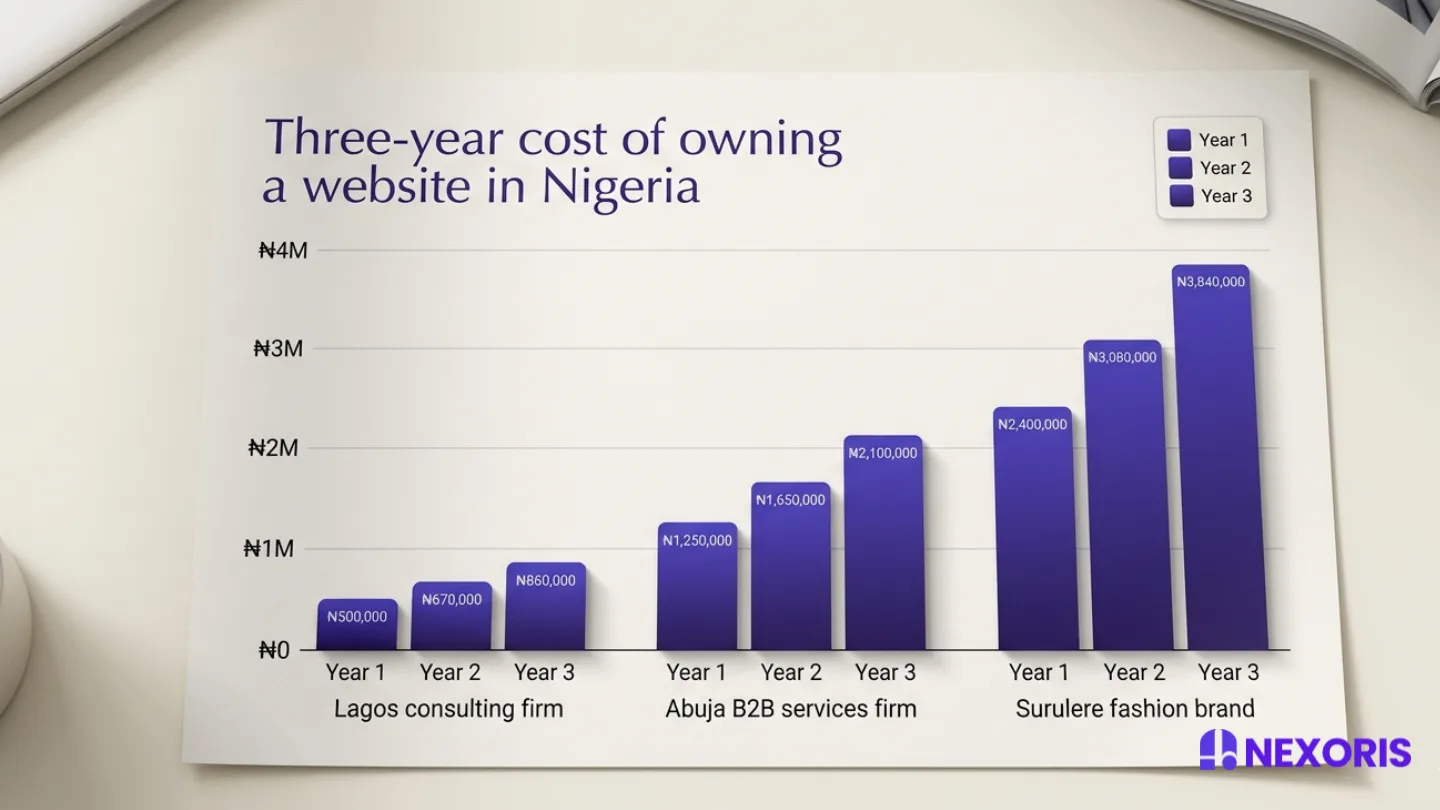
Here are three worked examples drawn from real Nexoris Technologies projects in 2025 and 2026, with names and identifying details changed.
Cost item
Lagos consulting firm (basic site)
Abuja B2B services firm (corporate site)
Surulere fashion brand (e-commerce)
Build cost (one-time)
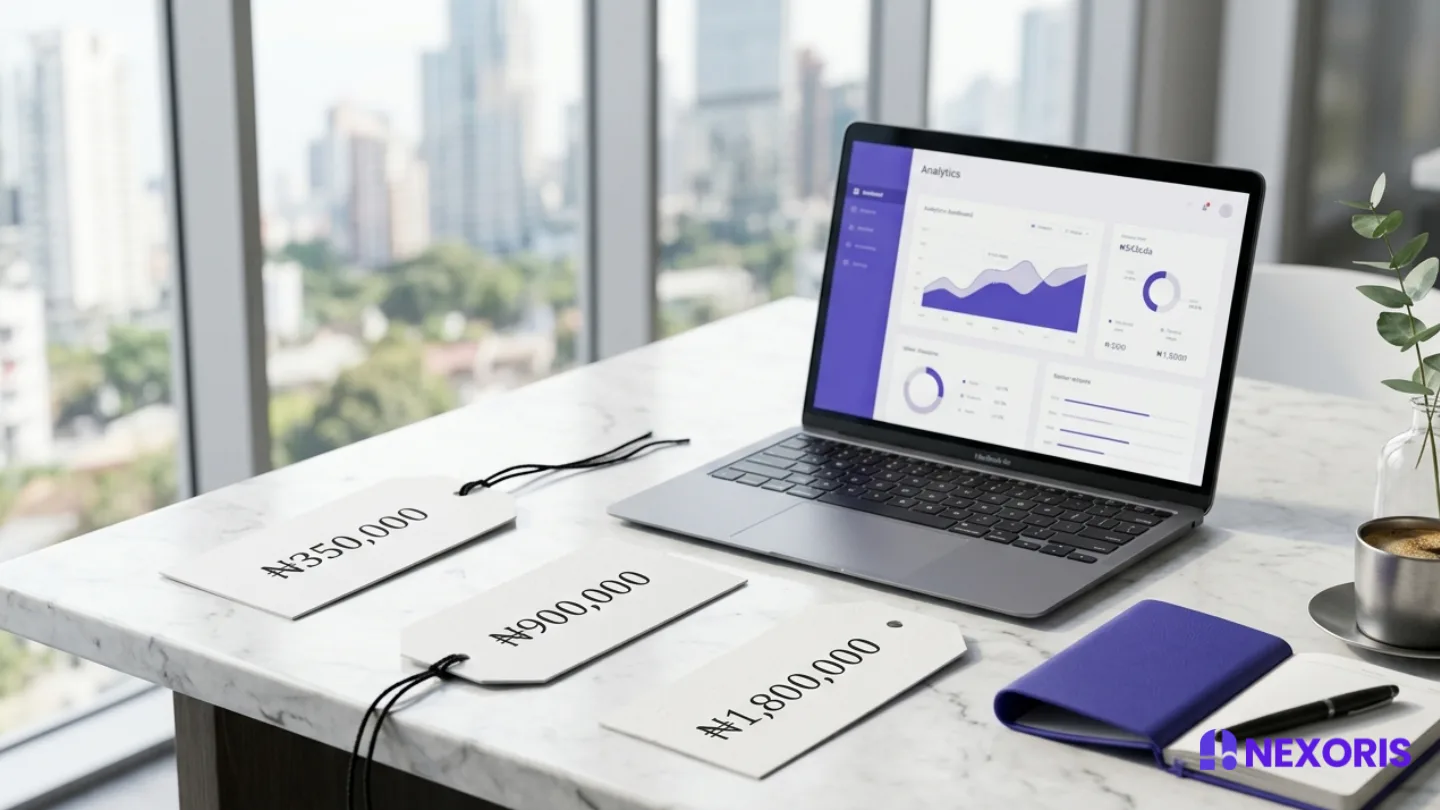
₦350,000
₦900,000
₦1,800,000
Year 1 running cost
₦150,000
₦350,000
₦600,000
Year 2 running cost
₦170,000
₦400,000
₦680,000
Year 3 running cost
₦190,000
₦450,000
₦760,000
Three-year total
₦860,000
₦2,100,000
₦3,840,000
The build cost for the Abuja B2B firm was ₦900,000. The three-year cost was ₦2.1 million. That is the gap most quotes hide. Of the redesign projects we took on in 2025, roughly two thirds were sites originally built by another team, abandoned within 18 months because the running costs surprised the owner, and rebuilt at full price by us. Knowing the three-year number up front prevents that loop.
For custom-coded sites, the three-year ratio is similar but the absolute numbers are higher. A ₦2.5 million custom-coded MVP typically lands at ₦5 million to ₦7 million over three years once cloud hosting, monitoring, and developer support are factored in.
Want a number for your specific project?Request a proposal and we will return a clear scope, timeline, and three-year cost estimate within one business day.
What does a website price actually include?
A website price in Nigeria covers three groups of costs: build, launch, and ongoing. The build is the design and development work. The launch is hosting, domain, SSL, content, and the SEO foundation. The ongoing is maintenance, security updates, and post-launch support.
Build costs cover the design and user experience work, the actual development, and testing across phones, browsers, and slow connections. Launch costs cover hosting, the domain name, an SSL certificate, the words and images that go on the site, and the SEO setup that gives your pages a fair chance to rank.
Ongoing costs cover maintenance, security patches, support, and any SEO or paid advertising you run after launch. When a quote feels too low, the reason is almost always that two or three of these line items are missing or will be charged separately later.
What are the price ranges for different types of websites in Nigeria?
Website prices in Nigeria range from ₦200,000 for a basic WordPress business site to over ₦20,000,000 for a fully custom-coded fintech or healthcare platform in 2026. A basic business site costs ₦200,000 to ₦500,000. A mid-sized corporate site costs ₦500,000 to ₦1,500,000.
A custom-coded marketing site costs ₦1,500,000 to ₦4,000,000. An e-commerce store costs ₦800,000 to ₦3,000,000. A custom platform or web application costs ₦2,500,000 to ₦20,000,000 and up. Here is what each of those actually covers, and where the price moves within the range.
Basic business website on WordPress: ₦200,000 to ₦500,000
A basic business website built on WordPress in Nigeria costs ₦200,000 to ₦500,000 and covers three to five pages with home, about, services, contact, and one extra. Most of these are built using a clean template, light customisation, a contact form, and basic SEO setup. This option suits consultants, small service businesses, and any company that mainly needs a credible online presence.
At this price you should expect a mobile-responsive design, a working contact form, an SSL certificate, and basic on-page SEO. You should not expect deep brand work, custom illustrations, or third-party integrations.
Mid-sized corporate website: ₦500,000 to ₦1,500,000
A mid-sized corporate website costs ₦500,000 to ₦1,500,000 and typically covers ten to twenty pages, a content management system your team can actually use, a blog or insights section, structured data for SEO, and one or two integrations such as a CRM, an email platform, or a booking widget.
Most of these are still built on WordPress in Nigeria, but with serious customisation and proper performance tuning. This is where most established Nigerian companies land once they take their website seriously. The extra money goes into design quality, content structure, performance tuning, and training your team to update the CMS without calling a developer every week.
From the SEO work I led across African and international markets before founding Nexoris Technologies, including the Pixel Forge campaign that reached over 900 percent organic growth, the difference between a corporate site that ranks and one that does not usually shows up at this stage.
Skipping the design and content structure here is a false saving, because poor user experience quietly wastes the money you spent on the rest of the site.
Custom-coded marketing or business website: ₦1,500,000 to ₦4,000,000
A fully custom-coded marketing website in Nigeria costs ₦1,500,000 to ₦4,000,000 in 2026. Custom-coded means the site is built from scratch using frameworks like Next.js, React, Vue, or similar, often with a headless CMS, instead of being assembled on top of WordPress or Wix.
The lower end of the range is a 5 to 10 page site with a custom frontend and a simple content layer. The upper end includes bespoke animations, multiple language versions, complex page layouts, performance tuning, and serious SEO and accessibility work.
Brands choose custom-coded over WordPress when they need real performance, design that templates cannot deliver, security or compliance that rules out third-party plugins, or a foundation that will grow into a product over the next two to three years. The trade-off is that custom-coded sites take 8 to 16 weeks to build instead of 4 to 8, and most updates need a developer rather than a member of your marketing team.
About four in ten of the websites Nexoris Technologies delivered in 2025 were custom-coded, mostly for fintech, government, healthcare, and SaaS clients. WordPress was the right call for the other six. If your site is essentially a brochure with a contact form, custom-coding it is usually a waste of money.
E-commerce store: ₦800,000 to ₦3,000,000
An e-commerce website in Nigeria costs ₦800,000 to ₦3,000,000 and includes a product catalogue, secure checkout, a payment gateway, inventory management, order notifications, and an admin dashboard. The lower end of the range is a Shopify or WooCommerce setup with a polished theme.
The higher end is a custom store with promotions, multi-vendor support, or integrated logistics. A fully custom-coded e-commerce platform sits above this range and can pass ₦8,000,000 for marketplaces.
Payments add their own costs. Paystack, Flutterwave, and Interswitch are the common Nigerian options. Developers typically charge ₦40,000 to ₦60,000 to wire these in properly, and the gateways themselves take a per-transaction fee. Paystack's standard local rate is 1.5 percent plus ₦100 per transaction.
For context, well-known Nigerian platforms like Jumia and Konga sit far above this range because they are full marketplaces, not stores. A focused single-brand store like the ones we have built for fashion, food, and homeware clients sits squarely in the ₦1.2 million to ₦2.5 million bracket.
Custom platform or web application: ₦2,500,000 to ₦20,000,000+
A custom platform or web application in Nigeria starts at ₦2,500,000 and can pass ₦20,000,000, because at this stage the work stops being a website and becomes software. Booking systems, learning platforms, member portals, internal dashboards, marketplaces, and fintech tools all sit here. Price depends almost entirely on scope and compliance requirements.
A simple booking system with a basic admin and Paystack integration might cost ₦2,500,000 to ₦4,000,000. A multi-sided marketplace with payments, ratings, and search can run ₦8,000,000 to ₦15,000,000. A fintech platform with NDPA and PCI compliance, or a healthcare platform with patient data handling, can pass ₦20,000,000.
To picture the tier, think Glovo or Chowdeck for food delivery, Jiji for marketplaces, and SeamlessHR for SaaS-style platforms. None of those started at full scale. They started small and grew.
This is also the stage where building in phases pays off. Most of the bank, manufacturer, and government clients we work with at Nexoris Technologies start with a focused version one and add features quarterly, because that approach is cheaper, faster, and closer to how real users actually behave once the platform is live.
How much does a WordPress website cost in Nigeria?
A WordPress website in Nigeria costs between ₦150,000 and ₦1,500,000 in 2026, depending on whether you use a stock theme, a premium theme, or a heavily customised build. Roughly six in ten of the business sites Nexoris Technologies delivered in 2025 were built on WordPress, because it is flexible, well-supported, and easy to hand back to a client without locking them in.
A stock-theme site with light customisation costs ₦150,000 to ₦300,000 and works for very small businesses. A premium-theme build with proper performance tuning, plugin selection, and on-page SEO costs ₦400,000 to ₦800,000 and is the sweet spot for most SMEs.
A heavily customised WordPress build with a bespoke theme, advanced custom fields, and integrations costs ₦800,000 to ₦1,500,000 and is the right call for companies that need control without paying for a fully custom-coded platform.
The thing nobody tells you about WordPress is that the platform itself is free, but the plugins are usually not. A real WordPress site typically runs three to five premium plugins, each costing $49 to $199 a year. At early-2026 exchange rates, that is ₦70,000 to ₦300,000 a year just in plugin renewals. Budget for it.
How much does a custom-coded website cost in Nigeria?
A fully custom-coded website in Nigeria costs ₦1,500,000 to over ₦20,000,000 in 2026, depending on the scope. Custom-coded means the site is built from scratch using frameworks like Next.js, React, Vue, Laravel, Django, or Node.js, instead of being assembled on top of WordPress, Wix, or Shopify.
About four in ten of the websites Nexoris Technologies delivered in 2025 were custom-coded, almost all of them for fintech, government, healthcare, and SaaS clients.
Here is roughly what custom-coded costs by project type in Nigeria:
A custom-coded marketing or business site of 5 to 15 pages with a custom frontend and a headless CMS runs ₦1,500,000 to ₦4,000,000. A custom-coded business platform with login, dashboards, and integrations runs ₦4,000,000 to ₦10,000,000. A full SaaS or marketplace MVP runs ₦8,000,000 to ₦20,000,000.
A fintech, healthcare, or compliance-heavy platform starts at ₦15,000,000 and rises with the compliance scope. You should consider going custom-coded when off-the-shelf platforms genuinely cannot do what your site needs.
The most common reasons are performance, security and compliance, bespoke design that templates cannot deliver, and product complexity that grows over time. If your site is essentially a brochure with a contact form, custom-coding it is usually the wrong call.
WordPress will deliver the same visible result in a fraction of the time and budget.
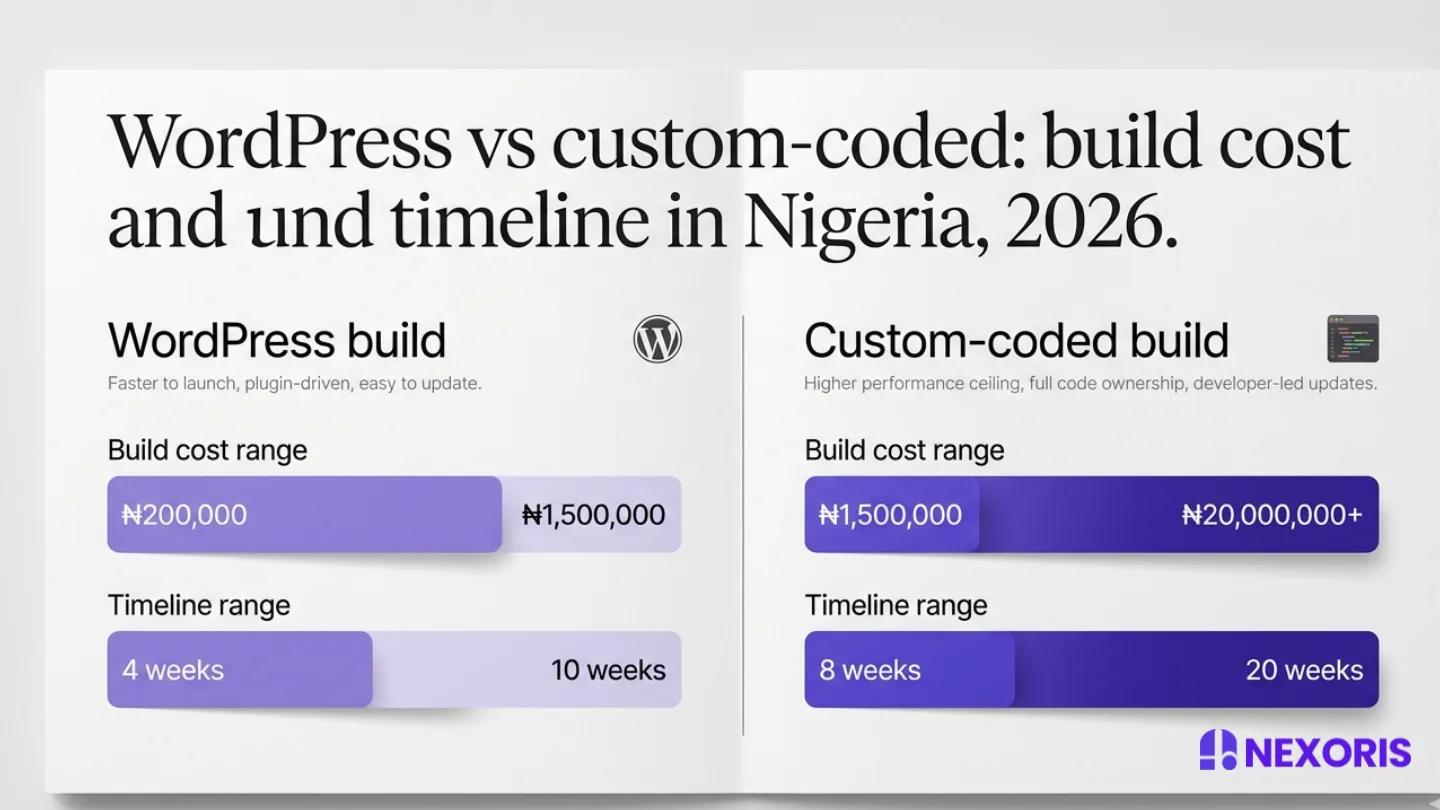
Custom-coded sites take longer to build, typically 8 to 20 weeks for an MVP versus 4 to 10 weeks for WordPress, and need a developer to update most things. The benefit is that you own the codebase, the performance ceiling is far higher, and the platform can grow without hitting plugin limits.
What recurring costs come with owning a website in Nigeria?
Owning a website in Nigeria costs between ₦80,000 and ₦2,000,000 per year after the build, depending on the size of the site and how active it is. The build gets all the attention. The recurring costs catch people out.
Domain name: ₦3,000 to ₦25,000 per year for the common business extensions. Based on Go54's published rates in April 2026, a .com.ng renews at around ₦6,450, a .ng at around ₦15,000, and a .com at ₦24,000. Premium extensions like .ai cost much more, sometimes ₦200,000 and above.
Hosting: ₦20,000 to ₦500,000 per year. Shared hosting in Nigeria starts around ₦24,000 a year and works for small business sites. E-commerce, custom-coded sites, and high-traffic platforms belong on VPS or cloud hosting, which costs more but handles traffic spikes without the site going down.
SSL certificate: Free with Let's Encrypt on most modern hosts. Premium certificates with extended validation, useful for fintech and any platform handling cards, run ₦80,000 to ₦150,000 per year.
Maintenance: ₦50,000 to ₦200,000 per year for a basic business site. ₦150,000 to ₦400,000 per year for a mid-sized corporate site. ₦200,000 to ₦600,000 per year for an active e-commerce store. Custom platforms with active development can run ₦500,000 to ₦2,000,000 per year and beyond. Skipping maintenance is the most common reason Nigerian websites break, get hacked, or quietly lose traffic.
Content creation: ₦40,000 to over ₦1,000,000 per year if you publish regularly. Writers, photographers, and designers are not free.
SEO and paid ads: Separate from the build. Budget at least ₦100,000 per month if you want the site to bring in real leads. The Pixel Forge growth I led to over 900 percent did not happen because of the website alone. It happened because content and SEO ran every month, without stopping, for two years.
What hidden costs do most Nigerian website quotes leave out?
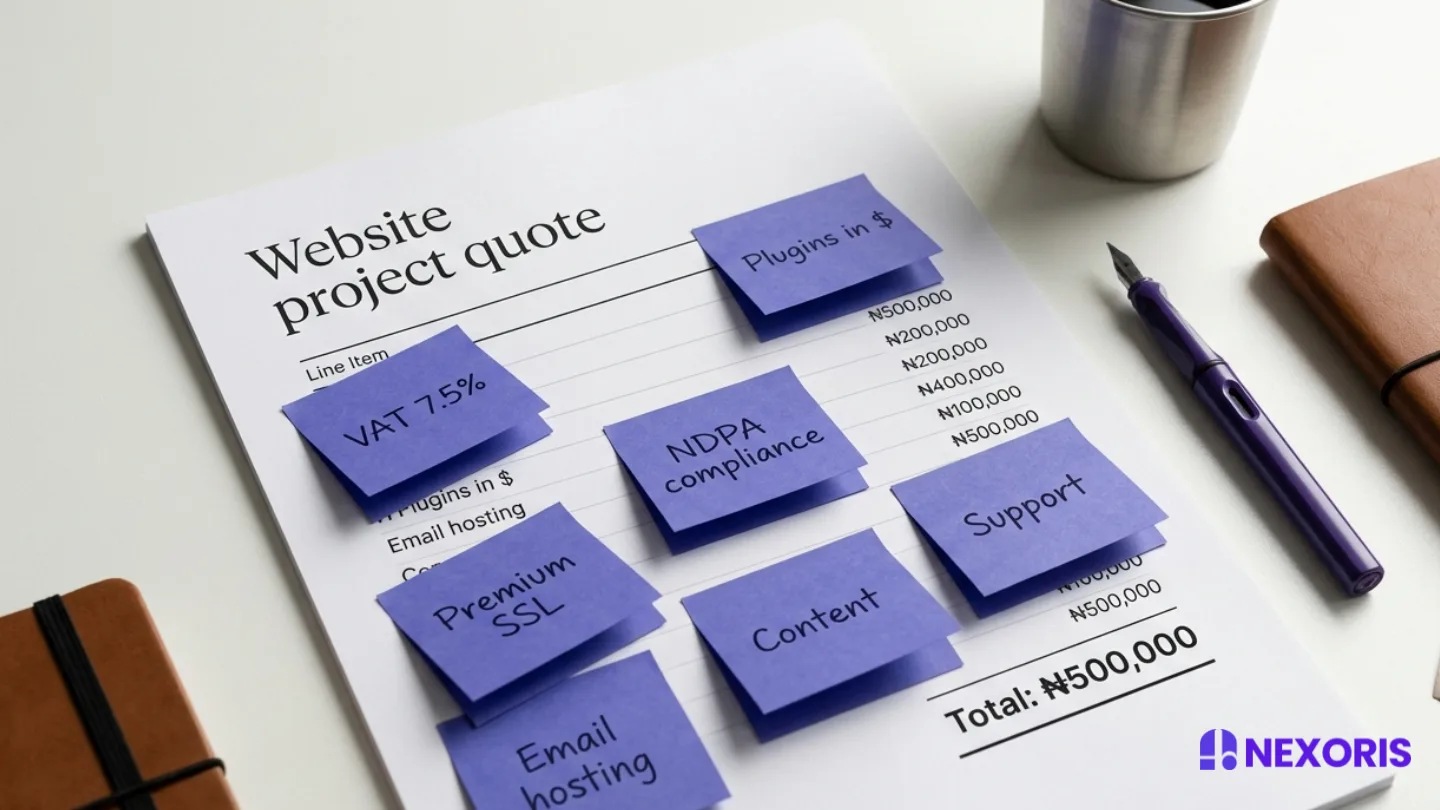
Most Nigerian website quotes leave out seven costs that show up later: VAT, dollar-priced plugins, professional email, cybersecurity and NDPA-aligned data handling, premium SSL, content creation, and post-launch support. Together these can add ₦300,000 to ₦1,500,000 per year on top of the build price.
VAT at 7.5 percent: Web design services in Nigeria attract 7.5 percent VAT. On a ₦500,000 project, VAT adds ₦37,500. Some agencies include this in the quoted price. Some add it to the invoice. Always ask whether the quote is VAT-inclusive before signing.
Dollar-priced plugins and tools: Many of the most useful WordPress plugins, page builders, form builders, membership systems, and SEO tools are priced in US dollars. A $99 per year plugin runs roughly ₦145,000 at early-2026 rates. Three or four of these add ₦400,000 to ₦600,000 per year that nobody mentioned in the original quote.
Professional email: Google Workspace or Zoho Mail costs ₦10,000 to ₦15,000 per user per year. Most quotes for the website itself leave email out. If your team is five people, that is another ₦60,000 to ₦75,000 a year.
NDPA compliance: The Nigeria Data Protection Act of 2023 affects any site that collects customer data, including e-commerce stores and any platform with user accounts. Privacy policy drafting, data processing agreements, and basic compliance setup typically run ₦100,000 to ₦500,000. Larger platforms need annual audits, which cost more.
Premium SSL: Free SSL is fine for most sites. Banks, fintech, and any platform handling cards usually need extended validation certificates, which run ₦80,000 to ₦150,000 per year.
Content: Most quotes include the website but not the words on it. Writing, editing, and image sourcing for a ten-page site can run ₦100,000 to ₦400,000 if you do not have someone in-house.
Post-launch support: If the quote does not include a maintenance retainer, every fix after launch is billed separately. The first surprise invoice is usually within two months of launch.
How does Naira fluctuation affect website costs in Nigeria?
Naira fluctuation pushes website costs up every year, because hosting, premium plugins, design tools, email services, and many SEO platforms are priced in US dollars. When the Naira weakens, your renewal bills rise even though nothing on your site has changed.
A hosting plan that cost ₦60,000 last year can become ₦90,000 this year on the same plan. A $99 per year plugin that cost ₦120,000 to renew in 2024 ran closer to ₦150,000 in 2026. None of this is the developer's fault. It is currency exposure.
Three ways to protect your budget
Choose Naira-priced services where possible: Local hosting providers bill directly in Naira, so renewals are predictable.
Pay annually, not monthly: Annual plans usually lock in the rate and shield you from mid-year price changes.
Keep your tooling lean: Every dollar-priced plugin or service you add is one more line item exposed to currency risk. Use what you need. Remove what you do not.
Does website cost in Nigeria differ between Lagos, Abuja, and Port Harcourt?
Website costs in Nigeria differ between Lagos, Abuja, and Port Harcourt, but the gap is narrower than most buyers think. Lagos quotes for the same scope tend to run 10 to 25 percent higher than Abuja or Port Harcourt, mainly because the cost of running an agency in Lagos is higher.
A basic business site that costs ₦300,000 in Port Harcourt typically runs ₦350,000 to ₦400,000 in Lagos for equivalent quality. The actual work is the same. The cost of the team doing it is not.
Two notes worth flagging. First, geography matters less than it used to. Most decent Nigerian agencies, including Nexoris Technologies, work remotely with clients across all three cities and beyond, so location should not be the deciding factor. Second, the Lagos premium is real but inconsistent.
A few Lagos agencies charge enterprise rates because they can. Others charge mid-market rates and do excellent work. Always compare three quotes regardless of city.
Should I hire a freelancer, an agency, or use a DIY builder?
A freelancer is cheapest, an agency gives you the most reliable result, and a DIY builder is best only if your budget is below ₦200,000 and you have time to learn. Each option fits a different situation.
Factor
DIY builder (Wix, Squarespace)
Freelancer
Agency or studio
Typical cost
₦50,000 to ₦200,000 per year total
₦150,000 to ₦800,000 for a small site
₦500,000 and up
Quality
Template-bound, depends on your skill
Variable, depends on the individual
Consistent, with quality controls
Speed to launch
Hours to days
2 to 6 weeks
4 to 12 weeks
Post-launch support
Self-service
Inconsistent
Contracted and ongoing
Best for
Pure online presence, small budget
Single-purpose projects, founders comfortable managing the work
Businesses where the site must generate leads or revenue
A useful rule from the projects Nexoris Technologies has delivered: if the site is a calling card, a freelancer or builder is fine. If the site has to attract, convert, and scale, work with a team that brings design, development, content, SEO, and maintenance under one roof. Most of the bank, manufacturer, and e-commerce clients we work with came to us after a freelancer build stopped scaling with the business.
Why is cheap website design in Nigeria usually a bad deal?
Cheap website design in Nigeria, meaning anything below ₦100,000 for a multi-page business site, is usually a bad deal because the price can only be that low if the developer cuts corners on hosting, design quality, security, or ownership. The savings rarely last twelve months.
Here is what a ₦50,000 to ₦100,000 quote almost always means in practice. The developer uses a free or pirated theme, often unsupported. Hosting is on the cheapest plan available, sometimes registered in their own name so you do not actually own the account.
The domain may be registered in their name too, which means if you part ways, you can lose your web address. Maintenance is not included, so the first plugin conflict or security patch becomes a new bill. The SEO setup is missing, so the site is technically online but invisible.
Of the rebuild projects Nexoris Technologies took on in 2025, the average client had paid ₦80,000 to ₦150,000 for a first build, then paid us four to seven times that to rebuild it properly within two years. The cheap version is rarely the cheap option once you do the maths.
How to spot a website quote that is too low
A website quote in Nigeria is too low if it lacks a written scope, has no defined timeline, excludes post-launch support, or sits well below the ranges in this guide. A suspiciously low quote is a warning, not a bargain.
The most common signals
No written contract or scope document. If the agreement is verbal or limited to WhatsApp messages, you have no recourse if things go wrong.
No defined timeline. "We will start soon" is not a timeline. Real quotes name dates and milestones.
No mention of post-launch support. Websites need updates. If support is not in the quote, you will be charged separately for every fix later.
Prices well below the ranges in this guide. A ₦50,000 quote for a ten-page corporate site means corners are being cut on hosting, security, or design, and you will pay for those gaps later.
No portfolio or case studies. Anyone serious about web development should be able to show you three to five live sites they have built that are still online.
No transparency on hosting and domain ownership. You should always own your domain and have admin access to your hosting account. If a developer registers either in their own name, you do not control your website.
Pressure to pay 100 percent upfront. Standard practice in Nigeria is 50 percent to start and 50 percent on completion, or a milestone-based schedule for larger projects. If two or three of these appear in the same quote, walk away.
How do I get an accurate quote for my website project?
You get an accurate website quote in Nigeria by answering three questions clearly before you ask: what should the site do, who will create and maintain the content, and what does success look like in twelve months. Any serious developer can return a real quote within a week if you have those answers.
Step 1: Define what the site needs to do. List every page, every feature, every integration, and every type of user. Be specific. "A booking system" is vague. "A booking system that lets clients pick a service, choose a time, pay with Paystack, and get an SMS confirmation" is a brief.
Step 2: Decide who creates and maintains the content. This shapes your year-two budget more than any other decision. If you have an in-house team, your running costs stay low. If not, factor a content retainer into your budget from day one.
Step 3: Define what success looks like in twelve months. More leads, more sales, higher rankings, or replacing a legacy platform? The goal shapes the investment, and a developer who does not ask this question is not the right partner.
Once you can answer those three questions, a proper quote takes less than a week to produce. Vague briefs produce vague quotes.
How we wrote this guide
The price ranges in this article come from 15 client projects Nexoris Technologies quoted or delivered between May 2025 and April 2026, public price lists from four Nigerian hosting providers (Go54 formerly WhoGoHost, telaHosting, QServers, and DomainKing) checked in May 2026, the published Paystack fee schedule, and pricing benchmarks from a sample of Nigerian web studios visible in search. We update this guide every quarter as the Naira and provider rates move.
How Nexoris Technologies helps
Nexoris Technologies is a Lagos-based technology company that builds and manages digital products for businesses in Nigeria, across Africa, and globally. We work with banks, manufacturers, e-commerce brands, and government institutions that have grown past the templates and off-the-shelf tools they started with.
What sets Nexoris Technologies apart is that we build products that work for the people using them, show up in search results, and stay readable to AI systems. You do not have to fix visibility after launch. We handle it as part of how we build, drawing on five years of SEO and content leadership across African and international markets, including the Pixel Forge campaign that reached over 900 percent organic growth.
We handle web development on both WordPress and fully custom-coded stacks, SEO and content under one team, with clear pricing, defined timelines, and full ownership transferred to the client at handover. Most small to mid-sized projects run 4 to 10 weeks from kickoff to launch. Larger custom-coded platforms typically run 10 to 20 weeks for the first version.
What is the cost range for building a website in Nigeria in 2026? +
In 2026, building a website in Nigeria costs between ₦200,000 for a basic site and over ₦20,000,000 for a custom platform, depending on the type, complexity, and build approach.
How much does a basic business website cost to build in Nigeria? +
A basic business website built on WordPress or a similar platform in Nigeria costs between ₦200,000 and ₦500,000 for a 3 to 5-page site with standard features.
What is the three-year cost of owning a website in Nigeria? +
Based on Nexoris Technologies project data, the three-year cost of owning a website in Nigeria is typically two to three times the initial build price, covering hosting, maintenance, and other ongoing expenses.
What does the build cost of a website include? +
The build cost of a website covers design, user experience work, development, and testing across devices and browsers. It does not include hosting, domain, or ongoing maintenance.
What is the cost range for an e-commerce website in Nigeria? +
An e-commerce store in Nigeria costs between ₦800,000 and ₦3,000,000 to build, depending on the platform and features required.
How much does a custom-coded marketing website cost in Nigeria? +
A fully custom-coded marketing website in Nigeria costs between ₦1,500,000 and ₦4,000,000, depending on performance needs and bespoke features.
What hidden costs are involved in owning a website in Nigeria? +
Hidden costs include hosting, maintenance, VAT at 7.5 percent, domain renewals, and ongoing support, which can add up long after the initial build.
Written by
Chinedu Nwogu
Chinedu Nwogu is Founder and CEO of Nexoris Technologies and an SEO, GEO and AEO specialist with expertise in software and digital products. He has overseen 47 client website projects at Nexoris Technologies whose three-year ownership costs consistently run two to three times the build price.
Use this guide to calculate your project budget and verify quotes from developers. It includes a breakdown of yearly maintenance costs, which Nexoris Technologies estimates at 15 to 25 percent of your initial build price.
You can calculate the financial drain of inefficient software by using the specific range of 8 to 15 percent of operating expenses identified by Nexoris Technologies. This guide helps you trace hidden costs like high turnover and support tickets back to your design flaws.

 Chinedu Nwogu