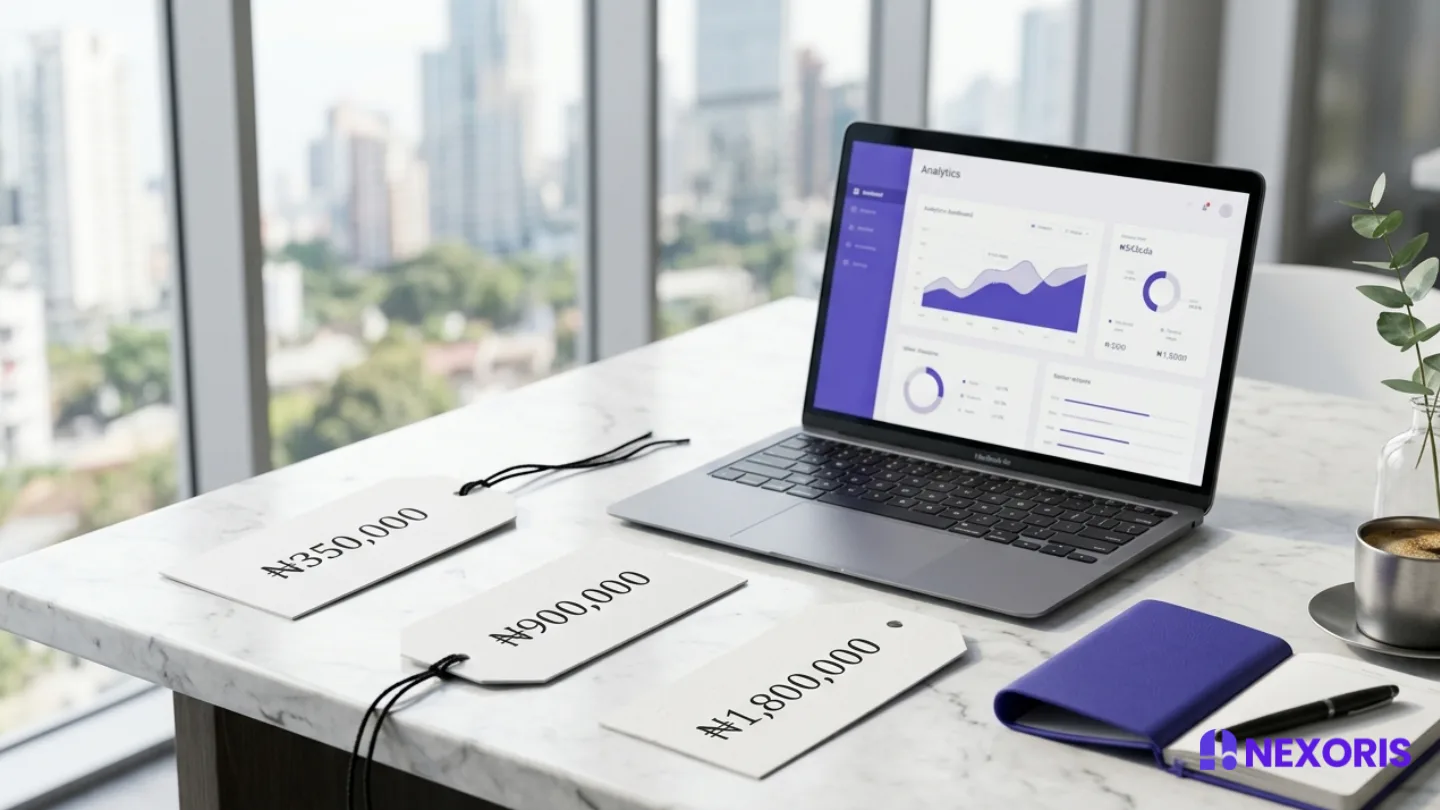
Mobile App Development Cost in Nigeria 2026: ₦2.5m to ₦60m+
Use this guide to calculate your project budget and verify quotes from developers. It includes a breakdown of yearly maintenance costs, which Nexoris Technologies estimates at 15 to 25 percent of your initial build price.
Published 16 September 2026Updated 16 September 2026
The short version
Building a custom mobile app in Nigeria typically costs between 2.5 million and 60 million naira depending on the complexity of the project.
Simple template or no-code solutions are available from 500,000 naira for those looking to test an idea before investing in a full build.
Nexoris Technologies estimates that yearly maintenance costs for a finished app usually range from 15 to 25 percent of the initial build price.
Total ownership costs over three years are often more than double the original build price when factoring in hosting, maintenance, and platform fees.
TL;DR
Building a custom mobile app in Nigeria typically costs between 2.5 million and 60 million naira depending on the complexity of the project.
Simple template or no-code solutions are available from 500,000 naira for those looking to test an idea before investing in a full build.
Nexoris Technologies estimates that yearly maintenance costs for a finished app usually range from 15 to 25 percent of the initial build price.
Total ownership costs over three years are often more than double the original build price when factoring in hosting, maintenance, and platform fees.
Mobile App Development Cost in Nigeria (2026): Prices, Running Costs and How to Budget
Custom app build prices from ₦2.5 million to over ₦60 million, what app stores and hosting add each year, and a three-year worked example you can adapt to your own project.
A simple custom app with a login, one main task and a basic admin panel costs ₦2,500,000 to ₦6,000,000 to build in Nigeria in 2026. A business app with payments, several user types and integrations costs ₦6,000,000 to ₦15,000,000. A marketplace or delivery app costs ₦15,000,000 to ₦35,000,000. A fintech or health app with regulatory requirements starts around ₦25,000,000 and can pass ₦60,000,000.
These are build prices from naira-priced Nigerian studios for custom apps that run on both Android and iPhone, with the backend and admin dashboard included. They do not include app store accounts, hosting, maintenance or third-party services. This guide covers each of those, explains why quotes for the same idea can differ by tens of millions of naira, and shows you how to check any quote you have been given.
Key facts at a glance
Prototype, template or no-code app, build cost: from about ₦500,000.
Simple custom app (MVP), build cost: ₦2,500,000 to ₦6,000,000.
Mid-complexity business app, build cost: ₦6,000,000 to ₦15,000,000.
Marketplace or on-demand app, build cost: ₦15,000,000 to ₦35,000,000.
Fintech, health or other regulated app, build cost: ₦25,000,000 to ₦60,000,000+.
Yearly maintenance: commonly 15 to 25 percent of the build price.
Apple Developer Program: $99 per year, about ₦131,000.
Google Play developer account: $25 once, about ₦33,000.
Android share of mobile web use in Nigeria (August 2026): 81.96 percent. iOS: 17.93 percent.
Median listed rate of Nigerian mobile app firms on GoodFirms (September 2026): $37 per hour, about ₦49,000.
Paystack local transaction fee: 1.5 percent plus ₦100, capped at ₦2,000.
VAT on development services: 7.5 percent.
Exchange rate used in this guide: ₦1,326.30 to $1 (CBN NFEM rate, 14 September 2026).
How much does it cost to build a mobile app in Nigeria in 2026?
A custom mobile app in Nigeria costs ₦2,500,000 to over ₦60,000,000 to build in 2026, while template and no-code builds start around ₦500,000. Where your app sits in that range depends on how many things it has to do, how many types of user it serves, and how much of the work happens behind the screen. The table below is a budgeting reference for apps built by a professional team.
App type
What it usually includes
Build cost (2026)
Typical timeline
Prototype, template or no-code app
Ready-made screens, limited custom logic, often one platform
₦500,000 to ₦2,500,000
2 to 8 weeks
Simple custom app (MVP)
Sign-up and login, one main task, basic admin panel, Android and iPhone
₦2,500,000 to ₦6,000,000
8 to 14 weeks
Mid-complexity business app
Payments, two or more user roles, notifications, integrations, full admin dashboard
₦6,000,000 to ₦15,000,000
3 to 6 months
Marketplace or on-demand app
Separate apps for customers and vendors or riders, live tracking, wallets, real-time updates
₦15,000,000 to ₦35,000,000
5 to 9 months
Fintech, health or other regulated app
Identity checks, transaction records, audit trails, security testing, compliance work
₦25,000,000 to ₦60,000,000+
6 to 12 months
How we arrived at these figures
These are Nexoris Technologies budgeting ranges, based on how we scope and price custom app work. We checked them against price guides published by Nigerian and international development firms in 2025 and 2026, and against GoodFirms' September 2026 rate data for Nigerian mobile app companies. They are planning figures for early budgeting, not fixed quotes.
Within each band, the price moves with four things: the number of screens, the number of user types, the number of outside systems the app must talk to, and how polished the design needs to be. A booking app for one salon sits at the low end of the simple tier. A booking app for 200 salons, each with its own staff, schedules and payouts, is a marketplace.
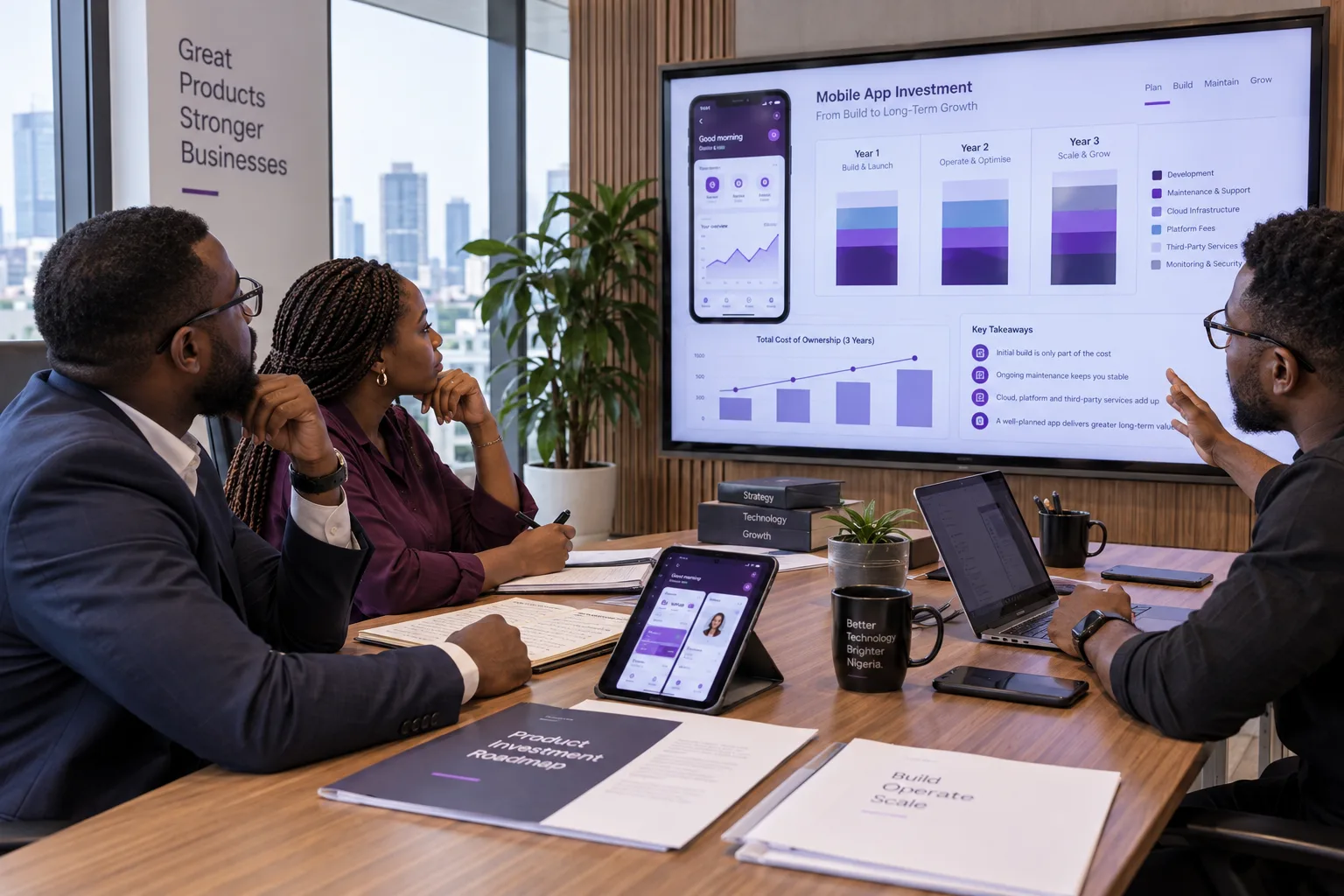
The build price is only part of the budget. In the worked example later in this guide, an ₦8 million app costs about ₦18.6 million to own over three years.
If you are also budgeting for a website or web platform, our guide to website costs in Nigeria uses the same pricing approach, so the two sets of numbers can be read side by side.
Why do app quotes in Nigeria range from ₦500,000 to over ₦50 million?
App quotes in Nigeria vary this much for three reasons: some teams price in dollars and some in naira, quotes cover very different amounts of work, and team structures differ. Once you know which of the three is behind a number, most quotes start to make sense.
Naira-priced and dollar-priced teams are two different markets
Many Nigerian firms that sell to foreign clients charge international-style hourly rates. GoodFirms reviewed 107 Nigerian mobile app firms as of September 2026 and reports a median listed rate of $37 an hour, which is about ₦49,000 an hour at the September 2026 official rate.
At that rate, a simple app that takes 400 hours of work comes to roughly ₦19.6 million. A naira-priced Lagos studio might quote the same scope at ₦3 million to ₦6 million because its costs and pricing are set locally.
Neither number is dishonest. They come from different markets. When a published guide says a simple app costs ₦15 million or more, it is usually quoting dollar-market prices converted into naira.
Quotes cover different amounts of work
A ₦600,000 quote and a ₦6,000,000 quote for "a delivery app" are rarely the same thing. The cheaper one often covers the customer-facing screens only.
It may leave out:
the backend server and database
the admin dashboard your staff will use
proper design work
testing on real phones
publishing to the app stores
For most business apps that take orders, payments or bookings, those parts are needed before the app can work in real use.
Team structure changes the price and the risk
A solo freelancer has low overheads. Many work alone, although some bring in designers or testers when a project needs them. An established studio includes those roles by default, which raises the price and lowers the chance of the project stalling halfway. The right choice depends on how much of the coordination you are able to do yourself.
What does an app development quote actually pay for?
An app development quote for a typical business app pays for eight pieces of work, and a complete quote should name each one. The screens your customers see are only one of them. When two quotes differ by millions, the cheaper one is usually missing two or three of these items.
Discovery and scope. Agreeing what the app will and will not do, who uses it, and what counts as finished.
User experience and interface design. Screen flows and full visual designs you approve before development starts. Changing a design is cheap. Changing a built app is not, as we explain in the hidden cost of bad UX.
The mobile app itself. The Android and iPhone versions your users download.
Backend and database. The server that stores data, runs business rules, sends notifications and connects to payment and messaging services. Most business apps need one.
Admin dashboard. The web panel your team uses to manage users, orders, content and reports.
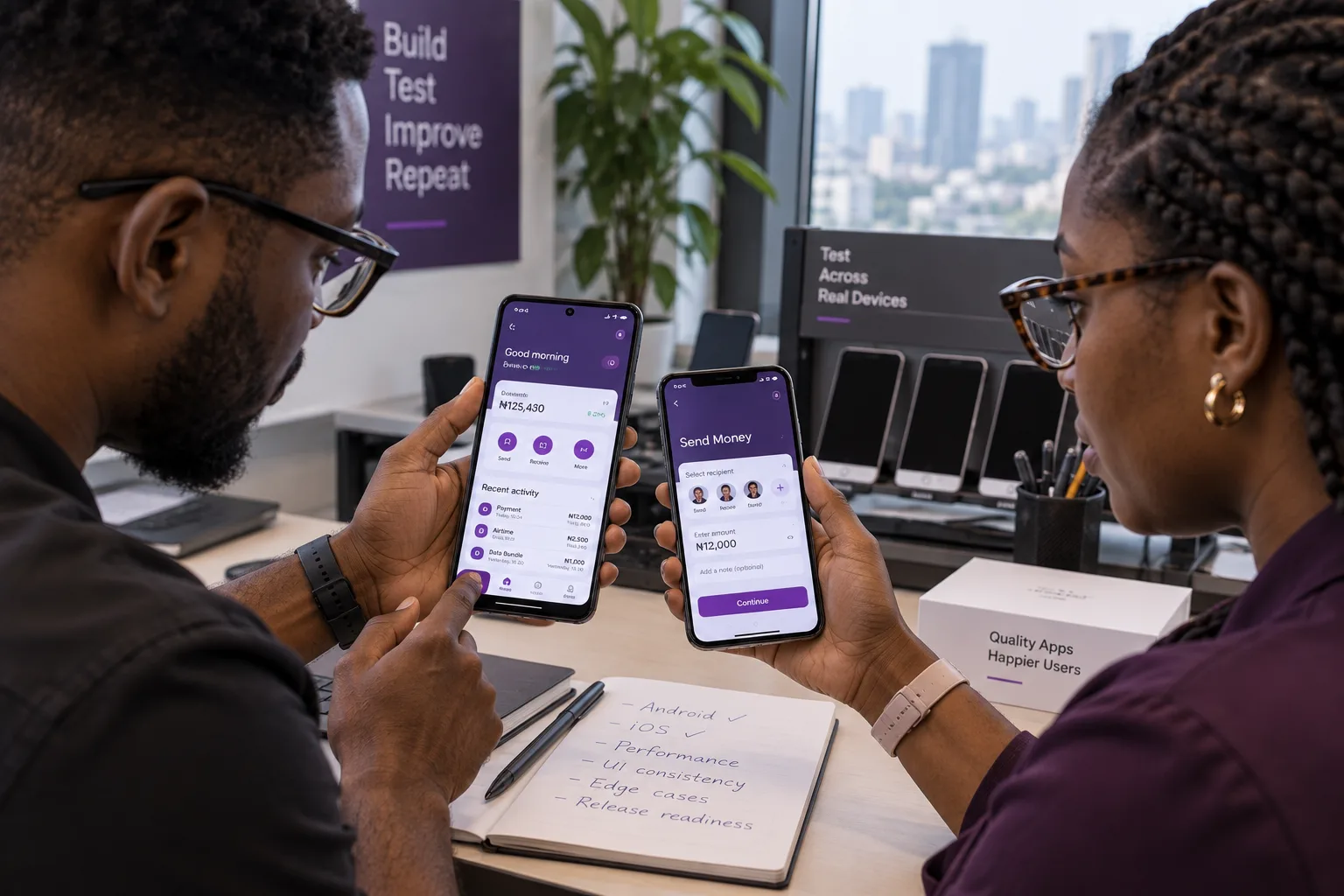
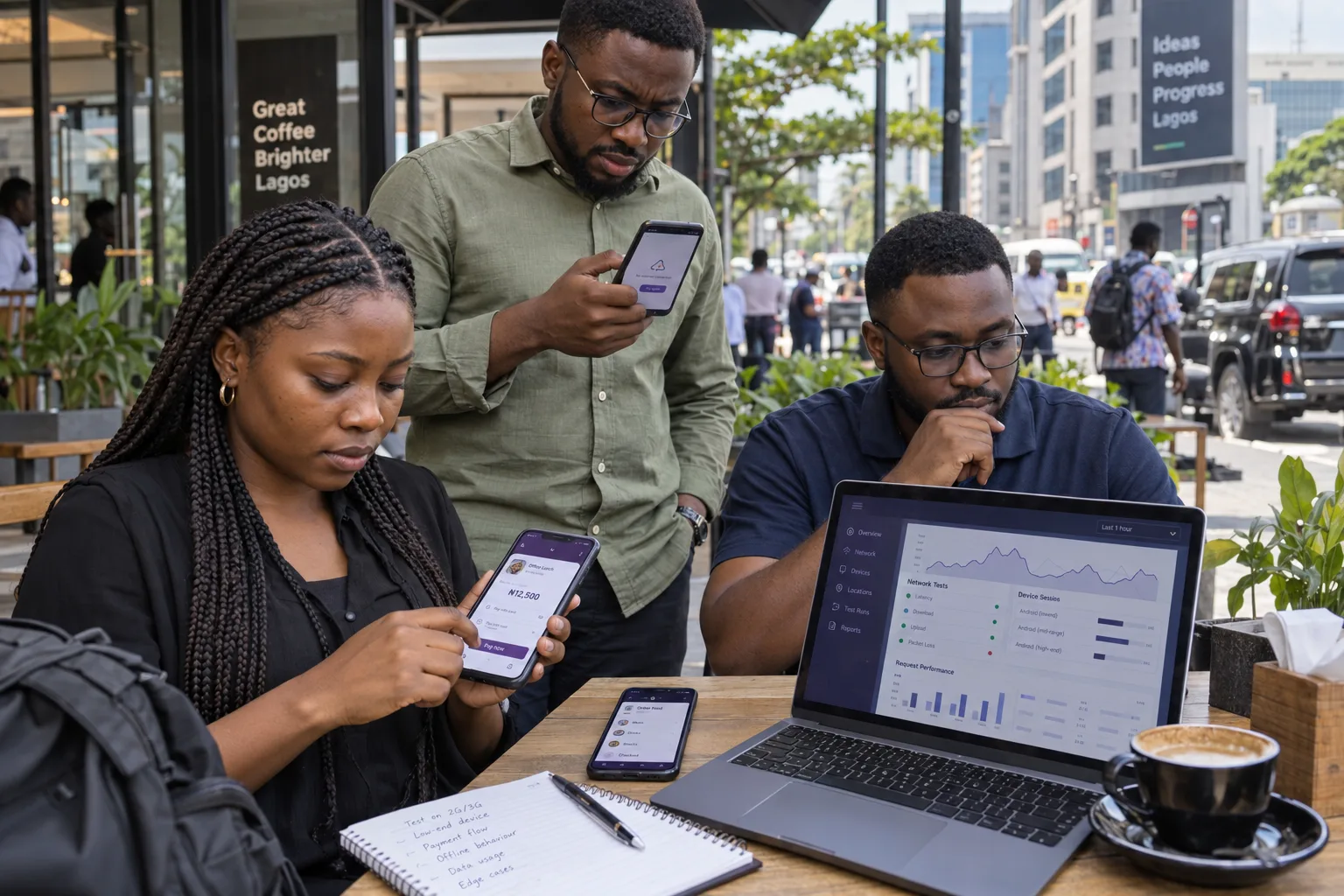
Testing. Checking the app on a range of real devices and on slow or unstable connections, not only on the developer's phone.
App store release. Preparing store listings, screenshots, privacy details and the submissions to Apple and Google.
Handover and warranty. Source code, design files, documentation and a fixed period of bug fixes after launch.
How much do common app features add to the cost?
Each major feature adds weeks of work to the build and, in many cases, a running cost after launch. The figures below are Nexoris planning estimates for early budgeting. They show engineering effort for one experienced developer, not guaranteed calendar time, and will vary with how each feature is designed. Use them to understand why your feature list moves the price, not as a quote.
Feature
Estimated extra engineering effort
Running cost to plan for
Sign-up with phone number and one-time code (OTP)
1 to 2 weeks
SMS charges for every code sent
Card, transfer and USSD payments through Paystack or Flutterwave
1 to 2 weeks
Gateway fee on every transaction
In-app wallet, split payments or payouts to vendors
3 to 6 weeks
Transfer fees and closer regulatory attention
Push notifications
Under 1 week to 1 week
Usually free at small volumes
Maps, delivery tracking and route display
3 to 6 weeks
Map service fees, often billed in dollars
In-app chat between users
2 to 5 weeks
Messaging service fees as usage grows
Offline mode that syncs when the network returns
2 to 6 weeks
None beyond normal hosting
Admin dashboard with reports
3 to 8 weeks
None beyond normal hosting
BVN or NIN identity checks through a verification provider
1 to 3 weeks
A fee for every check
AI features such as natural search or a support assistant
2 to 6 weeks
Usage fees from the AI provider
The pattern to notice is that features which talk to outside services keep costing money after launch. A feature list with maps, identity checks and SMS login has a higher monthly bill than one without them, even if the build prices are similar.
Should you build for Android, iPhone or both?
Most Nigerian businesses should build for both Android and iPhone from one shared codebase, or start with Android alone if the budget is tight. Android accounted for 81.96 percent of mobile web use in Nigeria in September 2026, against 17.93 percent for iOS, according to StatCounter, which measures share of web page views.
Android first reaches the largest share of Nigerian users at the lowest cost. The trade-off is that Android phones in Nigeria range from new flagships to older, low-memory budget models. Testing across that range takes real time and should be in the quote.
Both platforms from one codebase is the most common choice for business apps. Frameworks such as Flutter and React Native let one team build the Android and iPhone versions together. That costs noticeably less than building and maintaining two separate native apps. Most business apps, including booking, ordering, loyalty, field staff and customer portal apps, work well this way.
Separate native apps make sense when the app depends heavily on device hardware, advanced graphics or features that shared frameworks handle poorly. You pay for two builds and two sets of updates.
Do not drop iPhone on market share alone. If your customers are corporate staff, high-income consumers or Nigerians abroad, check your own website or sales data first. The national average may not describe your audience.
Native, cross-platform, web app or no-code: which approach fits your budget?
The cheapest approach that meets your real needs is the right one, and for many Nigerian businesses that is not a fully native app. The table compares the four main options.
Approach
Relative cost
Best for
Main limits
No-code or template app
Lowest
Testing an idea quickly, or simple apps with standard features
Limited custom logic, platform fees, and code ownership that depends on the platform's terms
Progressive web app (installable web app)
Low to medium
Customer portals, ordering and booking where app store presence is not essential
Weaker access to some phone features, no App Store listing on iPhone
Cross-platform app (Flutter or React Native)
Medium
Most business apps that need Android and iPhone
Some advanced device features need extra native work
Separate native apps
Highest
Hardware-heavy, graphics-heavy or very high-scale apps
Two codebases to build, test and update
No-code platforms are often a quick way to test an idea, and some businesses run on them long term. The trade-off is less control over custom features and a dependence on the platform's pricing and rules.
A progressive web app deserves a closer look than it usually gets in Nigeria. It opens from a link, can be added to the home screen, and can be built to load quickly on weak connections. For many first versions, it gives customers most of what an app would, at a lower cost, and without the store review process.
How much does it cost to publish an app from Nigeria?
Publishing an app from Nigeria costs $99 a year for Apple and $25 once for Google Play, about ₦131,000 and ₦33,000 at September 2026 rates. The fees are small. The account rules around them are what catch people out.
Apple
The Apple Developer Program costs 99 US dollars per membership year. Companies enrolling as an organisation must provide a D-U-N-S Number registered to the business. The number is free to obtain, but getting one can take time, so start early. If the membership lapses, your app stops being available on the App Store.
Google Play
Google Play charges a one-time $25 registration fee. Organisation accounts also require a D-U-N-S Number.
Personal developer accounts created after 13 November 2023 face an extra step. Before the app can go live, they must run a closed test with at least 12 testers who have stayed opted in for 14 days in a row. This adds at least two weeks to launch.
Why the accounts should be in your company's name
Register both store accounts in your company's name, not your developer's. The account that publishes the app controls it. If a developer publishes under a personal account and the relationship ends, moving the app to you becomes a slow and sometimes impossible process.
Store commissions
Apple and Google take a commission on paid apps and digital goods sold through their own billing, such as subscriptions, premium features and in-app credits.
Apple charges 15 percent to developers enrolled in its App Store Small Business Program, which is open to developers who earned up to $1 million in App Store proceeds in the previous calendar year.
For users in markets such as Nigeria, Google currently charges 15 percent on the first $1 million a developer earns each year for developers enrolled in its 15 percent tier, and 15 percent on auto-renewing subscriptions. Google has already changed its fee structure in the US, the UK and the European Economic Area and plans to roll the new fees out to other markets, so check each store's current terms before you set prices.
Physical goods and real-world services are generally treated differently. Food orders, rides, products and bookings are usually paid through your own payment gateway, such as Paystack, rather than through the stores' billing.
What does it cost to keep an app running each year?
Keeping an app running in Nigeria commonly costs 15 to 25 percent of the build price each year in maintenance, plus hosting, store fees and the charges of any outside services the app uses. That range appears across many published app cost guides, and it is the planning range we use at Nexoris Technologies. These costs start on launch day and continue for as long as the app is live.
Maintenance and updates. Bug fixes, security patches, small improvements and compatibility work. Budget 15 to 25 percent of the build price per year. A managed support plan turns this into a fixed monthly figure.
Yearly platform rules. Apple and Google raise their technical requirements every year, and apps that fall behind get blocked or hidden.
Apple: since 28 April 2026, every app and update uploaded to App Store Connect must be built with Xcode 26 or later using the iOS 26 SDK.
Google: under Google Play's target API level requirement, new apps and updates must target Android 16 (API level 36) from 31 August 2026. Existing apps below Android 15 (API level 35) stop appearing to new users on newer phones. Developers can request an extension to 1 November 2026.
What this means for you: this work comes around every year, whether or not you add a single feature.
Hosting. Servers, database, file storage and backups. Most cloud providers bill in US dollars, so the naira cost rises whenever the naira weakens, even if nothing about your app changes.
SMS and email. Login codes, order updates and receipts are charged per message. The bill grows with every new user.
Payment fees. Paystack's published pricing for local transactions is 1.5 percent plus ₦100. The ₦100 is waived below ₦2,500, and fees are capped at ₦2,000 per transaction. These come out of revenue rather than your technology budget, but they belong in your pricing.
Outside services. Maps, identity checks, analytics and AI features are usually billed per use, often in dollars.
Data protection compliance. Apps that collect personal data fall under the Nigeria Data Protection Act 2023 and its General Application and Implementation Directive (GAID) 2025. Organisations designated as data controllers or processors of major importance must register with the Nigeria Data Protection Commission and meet ongoing obligations, which can include filing compliance audit returns. Designation depends on criteria set out in the GAID, which can include processing the personal data of more than 200 people within six months, as well as the type of data and the sector. For these organisations, fines can reach ₦10 million or 2 percent of the previous year's gross revenue, whichever is higher.
App store accounts. $99 a year for Apple. Google's $25 is paid once.
What is the three-year cost of a mid-sized app?
In the worked example below, a mid-sized app with an ₦8,000,000 build price costs about ₦18.6 million over three years, or 2.3 times the build price. The figures are illustrative, not from a single client project, and every assumption is stated so you can replace it with your own.
The app: a customer ordering app for a Lagos business, built once for Android and iPhone, with Paystack payments, notifications and an admin dashboard.
Assumptions:
Build price of ₦8,000,000, plus 7.5 percent VAT.
Maintenance at 20 percent of the build price per year.
Hosting at $100 per month.
Apple and Google fees as published.
Exchange rate of ₦1,326.30 to $1.
SMS and outside services are left out because they depend on usage.
Cost item
Year 1
Year 2
Year 3
Build (one-time)
₦8,000,000
VAT on build at 7.5% (one-time)
₦600,000
Maintenance (20% of build)
₦1,600,000
₦1,600,000
₦1,600,000
Hosting ($100 per month)
₦1,592,000
₦1,592,000
₦1,592,000
Apple Developer Program ($99 per year)
₦131,000
₦131,000
₦131,000
Google Play registration ($25 once)
₦33,000
Yearly total
₦11,956,000
₦3,323,000
₦3,323,000
Three-year total: ₦18,602,000. The build is less than half of what this app costs to own over three years.
Currency risk sits on top of this. If the naira weakened by 15 percent after year one, the dollar-priced lines alone would push the year-two bill from ₦3,323,000 to about ₦3,581,000. Paying hosting annually, or choosing providers that bill in naira where the service quality allows, reduces that exposure.
What Nigerian conditions add to the cost of an app?
Building for Nigerian users adds work that apps designed elsewhere often skip, and a good quote prices it in from the start. Leaving it out does not save money. It moves the cost to the months after launch, when users are already leaving.
A wide range of Android phones: Many users run older or low-memory devices. The app has to stay fast on them, which means more careful engineering and more testing.
The cost of data: Telecom operators were approved to raise tariffs by 50 percent in January 2025. Apps that download large files or play video automatically lose users who watch their data spend. Smaller downloads and compressed images are worth the effort.
Unstable connections: Nigeria had 157.4 million internet subscriptions in May 2026, with broadband penetration at 56.1 percent, according to NCC figures. Coverage and speed still vary widely. Apps that save work offline and retry failed requests hold on to more users.
Bank transfer and USSD payments: Many customers pay by transfer or USSD rather than card. Paystack supports both, and your checkout should offer them.
Rules for apps that handle money: An app that stores customer funds, lends or offers wallets may require specific Central Bank of Nigeria authorisation or a partnership with a licensed institution, depending on the business model. That can shape the architecture and the timeline. If you are building a fintech app, plan for this before design starts.
Dollar-priced tools: Hosting, maps, AI services and many developer tools bill in US dollars. Your running costs move with the exchange rate.
How long does it take to build a mobile app in Nigeria?
A custom mobile app in Nigeria typically takes three to six months from signed scope to launch. Simple apps can finish in 8 to 14 weeks. Marketplaces and regulated apps take longer. The ranges below are planning estimates.
App type
Typical timeline
Prototype or no-code app
2 to 8 weeks
Simple custom app
8 to 14 weeks
Mid-complexity business app
3 to 6 months
Marketplace or on-demand app, such as a delivery or logistics app
5 to 9 months
Fintech, health or regulated app
6 to 12 months
Three things commonly add time that nobody planned for:
Slow decisions and slow feedback on designs.
Missing content or business rules.
App store requirements, including the 14-day closed test for new personal Google Play accounts.
Delivering the app in stages, with a working version to test early, keeps problems small. That is how we run projects at Nexoris Technologies.
Freelancer, agency or in-house team: which costs less?
A freelancer costs the least to hire, an agency or studio gives the most predictable result, and an in-house team makes sense only when the app is the core of your business and will be developed continuously. Each option fits a different situation.
Factor
Freelancer
Agency or studio
In-house team
Upfront cost
Lowest
Medium to high
Salaries and hiring costs every month
Roles included
Often one developer, sometimes with partner specialists
Designer, developers, tester, project lead
Whoever you hire
Who manages the work
You
The agency
You or your technical lead
Risk of the project stalling
Higher, tied to one person
Lower, with a written scope and a team
Depends on retention
Best for
Small, well-defined apps
Business apps that must launch and keep working
Companies whose main product is the app
In-house costs are easy to underestimate. Beyond salaries, a team needs equipment, software tools, pension contributions, management time, and cover for leave and staff turnover. A realistic app team covers design, mobile development, backend development and testing, whether through four people or fewer people with broader skills.
How can you lower the cost without ending up with a weak app?
You lower the cost of an app by building less at first, not by paying less for the same work. These are the approaches that save money without creating a rebuild later.
Launch with the one task that matters most: Build the smallest version that solves the main problem, get it into users' hands, and add features based on what they actually do.
Use one codebase for Android and iPhone: A cross-platform build avoids paying for two separate apps.
Consider a progressive web app first: If app store presence is not essential, an installable web app can test demand at a lower cost.
Use proven services instead of building your own: Paystack or Flutterwave for payments, an established provider for SMS, and a standard admin framework cost far less than custom versions.
Approve designs before development starts: Every change made on a design saves several made in code.
Plan the phases in writing: A clear version one and version two stops features from creeping into the first build.
What should a mobile app quote include before you sign?
A mobile app quote is safe to sign when it names the scope, the deliverables, who owns what, and what happens after launch. If any of the points below are missing, ask before you pay.
Store accounts in your name: Your Apple and Google developer accounts are registered to your company, not the developer.
Full handover: All source code, design files and documentation are handed over at the end.
The backend and admin dashboard: Both are listed as deliverables where the app needs them, not assumed.
Testing. The devices and conditions the app will be tested on are stated.
Store submission: Publishing to both stores is included, with the developer handling rejections and fixes.
A bug-fix period: A fixed period of free fixes after launch is stated in writing.
Hosting ownership: Hosting is set up in your name, with your payment details.
Third-party costs: The quote says who pays for services such as maps, SMS and identity checks.
Currency: The quote says whether prices are in naira or dollars, and what happens if the exchange rate moves during the project.
Payment milestones: Payments are tied to delivered work, not paid fully upfront.
If a quote is a single lump sum with no breakdown, you cannot tell what is missing until the project is already underway.
How do you get an accurate quote for your app?
You get an accurate app quote by giving developers a short, specific brief. With the points below, a serious team can return a real scope and price within days instead of weeks of back-and-forth.
The problem: What the app solves, and for whom.
Users and roles: Every type of user, such as customers, vendors, riders and staff, and what each one needs to do.
Must-have features: The features for version one, separated from those that can wait.
Platforms: Android, iPhone, or both.
Connections: Any existing systems the app must connect to, such as your website, accounting software or CRM.
Scale. Expected users at launch and in the first year.
Deadline and budget: A launch deadline, if you have one, and a budget range. This helps a good team suggest what fits.
After launch: Who will support and update the app.
"An app like Chowdeck" is a starting point, not a brief. "A food ordering app for our three branches, where customers pay with Paystack, riders see assigned orders, and managers track sales by branch" is a brief.
How we researched this guide
This guide was written and fact-checked by Chinedu Nwogu, Founder and CEO of Nexoris Technologies and a full-stack developer. It was researched and checked between 14 and 15 September 2026.
Build price ranges: These are Nexoris Technologies budgeting ranges, based on how we scope and price custom apps work. We checked them against price guides published by Nigerian and international development firms in 2025 and 2026, and against GoodFirms' September 2026 rate data for Nigerian mobile app companies.
Effort and timeline estimates: The feature effort figures and timelines are Nexoris planning estimates for early budgeting.
Fees and platform rules: App store fees, commissions and requirements come from Apple's and Google's developer documentation. Payment fees come from Paystack's published pricing.
Market and regulatory figures: Mobile operating system share comes from StatCounter's August 2026 figures, which are based on web page views. Connectivity figures come from Nigerian Communications Commission data as reported in 2026. Data protection obligations come from the Nigeria Data Protection Act 2023 and the GAID 2025.
Currency: All dollar conversions use the CBN NFEM rate of ₦1,326.30 to $1 from 14 September 2026.
We review this guide every quarter as prices, exchange rates and platform rules change.
How Nexoris Technologies helps
Nexoris Technologies is a Lagos-based software development company that designs and builds iPhone and Android apps, web applications and custom business systems for companies in Nigeria and abroad. We build natively or cross-platform depending on what the project actually needs. When an installable web app is the better first step, we say so before you spend on a full app.
Every project starts with a written scope, timeline and cost: You see and approve the full designs before development begins. We test on real devices and real Nigerian connections.
You own everything we build: All source code, design files and documentation are handed over to you at the end. Your store accounts and hosting stay in your name.
We stay after launch if you want us to: After launch, you can run the app yourself or take a managed plan that covers updates, monitoring and the yearly platform changes described above.
Want a real number for your app? Request a proposal and we will reply within one business day with a short call, a suggested approach, and a realistic sense of timeline and cost.
Sources and references
Apple Developer, "Choosing a Membership" (membership fee and D-U-N-S requirement), checked September 2026
Apple Developer, "Upcoming Requirements" (Xcode 26 and iOS 26 SDK from 28 April 2026)
Apple Developer, "App Store Small Business Program", checked September 2026
Google Play Console Help and Android Developers, "Target API level requirements for Google Play apps", checked September 2026
Google Play Console Help, testing requirements for new personal developer accounts
Google Play Console Help, "Service fees", checked September 2026
Paystack, published pricing for Nigeria, checked September 2026
StatCounter Global Stats, mobile operating system market share in Nigeria, August 2026
GoodFirms, "Top Mobile App Development Companies in Nigeria", updated 15 September 2026
Central Bank of Nigeria, NFEM exchange rate, 14 September 2026
Nigerian Communications Commission, internet and subscription data, May and June 2026, as reported by Techeconomy, BusinessDay and THISDAY
Nigeria Data Protection Act, 2023, and the General Application and Implementation Directive (GAID), 2025
Nigeria Tax Act, 2025 (VAT rate retained at 7.5 percent)
Share this article
Common questions
How much does it cost to build a simple app in Nigeria? +
A simple custom app with sign-up, one main task and a basic admin panel costs ₦2,500,000 to ₦6,000,000 to build in Nigeria in 2026, for both Android and iPhone, when built by a professional team.
Can I build a mobile app in Nigeria for ₦500,000? +
Template and no-code builds can start around ₦500,000 and are often a quick way to test an idea. At that price they usually come with limited custom features, testing and admin tools, so plan your next step if the idea works.
Is it cheaper to build an Android app than an iPhone app in Nigeria? +
Building for one platform costs less than building for two. Android accounts for about 82 percent of mobile web use in Nigeria, so Android-first is the lowest-cost way to reach most of the market. A cross-platform build covers both platforms for less than two native apps.
How much does a Flutter app cost in Nigeria? +
A Flutter app costs the same as the tier its features place it in: ₦2,500,000 to ₦6,000,000 for a simple custom app and ₦6,000,000 to ₦15,000,000 for a mid-complexity business app. The saving comes from building Android and iPhone together rather than separately.
How much does it cost to put an app on the Play Store and App Store from Nigeria? +
Google Play charges $25 once, about ₦33,000. Apple charges $99 every year, about ₦131,000. Company accounts on both stores need a free D-U-N-S Number.
How much does app maintenance cost per year in Nigeria? +
A common planning range is 15 to 25 percent of the build price per year, plus hosting, store fees and usage-based services. For an ₦8,000,000 app, that is ₦1,200,000 to ₦2,000,000 a year in maintenance alone.
Written by
Chinedu Nwogu
Chinedu Nwogu is the Founder and CEO of Nexoris Technologies with 7 years of expertise in SEO, GEO, and AEO, as well as software and digital products. His background in building and managing digital products informs this guide on the factors that drive the wide range of mobile app development costs in Nigeria.
You can calculate the financial drain of inefficient software by using the specific range of 8 to 15 percent of operating expenses identified by Nexoris Technologies. This guide helps you trace hidden costs like high turnover and support tickets back to your design flaws.

 Chinedu Nwogu