IoT Development for Manufacturing in Nigeria: Applications, Benefits and Implementation
You can use this guide to evaluate if your factory infrastructure is ready for digital monitoring and to plan your own deployment. It breaks down the five-stage data flow used by Nexoris Technologies to move information from machine sensors into actionable maintenance reports.
Industrial IoT helps manufacturers track machine performance in real time to prevent unexpected failures.
Nexoris Technologies notes that these systems connect sensors and equipment to software to provide actionable operational data.
Successful implementation requires adapting to local challenges like unstable power and existing factory infrastructure.
The process involves collecting data from machines, transmitting it through gateways, and using analytics to guide maintenance and production decisions.
A production manager usually knows when a machine has stopped. What is harder to know is when its performance started to slip, how long it ran below its normal standard, and how that slowdown affected the rest of the line. By the time the machine fails, some of that information may already be lost, or may never have been recorded.
IoT development for manufacturing in Nigeria is about closing that gap. Industrial IoT (IIoT) solutions for manufacturing connect production equipment, sensors and software platforms so that operational data reaches the people who need it, in a form they can act on. Maintenance teams can see equipment conditions earlier. Production managers can see output as it happens. Management gets operational records to work from, although the quality of the data and the checks applied to it decide how far those records can be trusted.
The Nigerian setting shapes how these systems should be designed. Unreliable connectivity, unstable power, older machines, existing factory software and implementation costs all affect what will work. This guide explains what industrial IoT is, how it works inside a factory, where it is useful, what implementation involves and what to consider before investing.
What Is IoT Development in Manufacturing?
Industrial IoT development in manufacturing involves connecting factory machines, sensors and other industrial equipment to software systems that collect, process and present operational data. This enables manufacturers to monitor equipment, track production conditions, receive alerts and make decisions based on information from their own operations.
Four related terms are often mixed up, so it helps to separate them:
Internet of Things (IoT): Physical devices that collect data and exchange it with other devices or software over a network.
Industrial Internet of Things (IIoT): IoT technologies applied in industrial settings such as factories and production facilities, where reliability, safety and security requirements are stricter.
Industrial automation: Technologies that control or automate industrial processes, for example programmable logic controllers (PLCs) that run a machine's operating sequence.
Manufacturing software: Applications that manage production, inventory, procurement, quality and other business operations, such as ERP and manufacturing execution systems.
These technologies often work together, but they are not interchangeable. A PLC controls a machine. An IIoT platform collects and presents data about that machine. An ERP system records what the business needs to buy, make and sell. Confusing them leads to poorly scoped projects.
How Does Industrial IoT Work in a Manufacturing Facility?
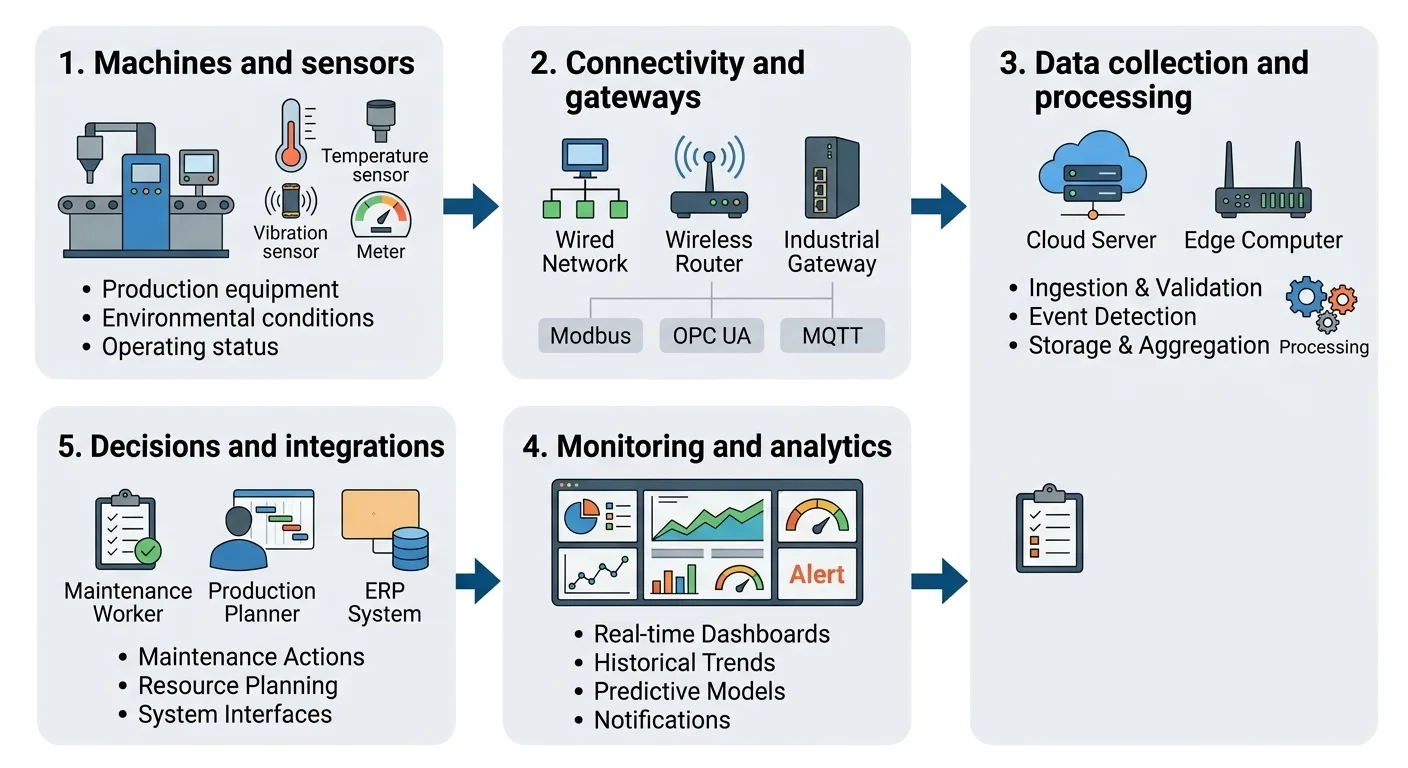
Most industrial IoT systems follow the same five-stage data flow:
Machines and sensors: Production equipment, meters, temperature sensors, vibration sensors and other connected devices produce readings.
Connectivity and gateways: Industrial networks, gateways and communication protocols carry those readings onward.
Data collection and processing: The platform receives, validates, stores and processes the data and detects events.
Monitoring and analytics: Dashboards, trends, alerts and reports turn the data into information people can use.
Decisions and integrations: Maintenance actions, production planning and links to ERP or other business systems put that information to work.
industrial IoT data flow · 5 stages
Each stage passes its output to the next, and the last stage is where people act on it.
This is an illustrative flow. Actual architectures vary with the equipment, connectivity, security needs and operational goals of each factory.
An illustrative end-to-end scenario. A factory connects selected production machines to a monitoring platform. The system records operating status, temperature and production counts, and a gateway sends the readings to the platform. When a configured threshold is exceeded, the maintenance team receives an alert. The equipment history is then available for investigation, and the maintenance workflow can record the inspection. This is an example of how the parts fit together, not a description of a completed Nexoris project.
Connecting machines and industrial sensors
Some machines already produce useful data, such as running status, fault codes or production counts. Where equipment does not expose what you need, sensors can capture it. Common measurements include:
Temperature and humidity.
Vibration and equipment movement.
Pressure and flow.
Electrical consumption and power quality.
Machine operating status and production counts.
The point is to measure what helps a decision, not to measure everything. A sensor that nobody uses adds cost and maintenance work without adding value.
Transmitting data through industrial networks and gateways
A gateway is a device that collects data from machines and sensors and passes it to a wider system, often converting between communication methods along the way. Several communication technologies are common in this space:
Modbus: A long-established protocol used by many industrial devices and meters, available over serial connections and Ethernet.
OPC UA: A platform-independent standard for exchanging industrial data, maintained by the OPC Foundation.
MQTT: A lightweight publish and subscribe messaging protocol widely used to move device data to software platforms.
Ethernet and wireless connectivity: Network technologies used to connect industrial equipment, gateways and monitoring platforms. The appropriate option depends on communication distance, reliability, interference, bandwidth and the factory environment.
The right choice depends on the equipment and the architecture. A given factory will not use all of these, and a good design starts from what the machines already support.
Separating equipment monitoring from machine control
An industrial IoT monitoring platform does not necessarily control the production machine. Existing PLCs and industrial control systems may continue to operate independently, while the monitoring platform reads data from them or from added sensors.
Connecting monitoring software to industrial equipment calls for care about network security, operational safety and the consequences of sending commands back to a machine. A monitoring integration should never interfere with machine control or safety functions. If a project later involves sending commands to equipment, it needs separate engineering review, because a wrong command in a factory can damage equipment or put people at risk.
Processing and storing operational data
Raw readings become useful only after they are timestamped, checked for validity, stored and processed. A missing reading, a communication timeout or an invalid sensor-status flag should be identified as a data-quality or connectivity issue, not treated as a genuine measurement. Systems can use timestamps, device health indicators, communication heartbeats and validation rules to tell missing or unreliable data apart from real operating conditions.
Some of this processing can happen close to the equipment, which is called edge processing. Edge processing is helpful when a decision must be made quickly or when the network connection is poor. Other processing happens on a centralised platform, which suits long-term storage, comparison across machines and reporting. Many systems use both.
Presenting information through dashboards and alerts
Operators and managers use dashboards to see equipment status, historical trends, notifications, reports and performance indicators. Dashboards are only as good as the data behind them. If readings are unreliable or the indicators do not relate to real decisions, people stop looking at them. Good design starts by asking who needs which information, and when.
7 Practical Applications of IoT in Nigerian Manufacturing
IoT is used in manufacturing for machine monitoring, maintenance, production tracking, energy monitoring, environmental monitoring, quality investigation and asset tracking. The seven applications below connect the technology to everyday factory problems.
1. Real-time machine and equipment monitoring
Connected equipment lets manufacturers see:
Whether machines are running, idle or stopped.
Operating temperature, vibration and pressure.
Abnormal operating conditions.
Equipment utilisation and operating hours.
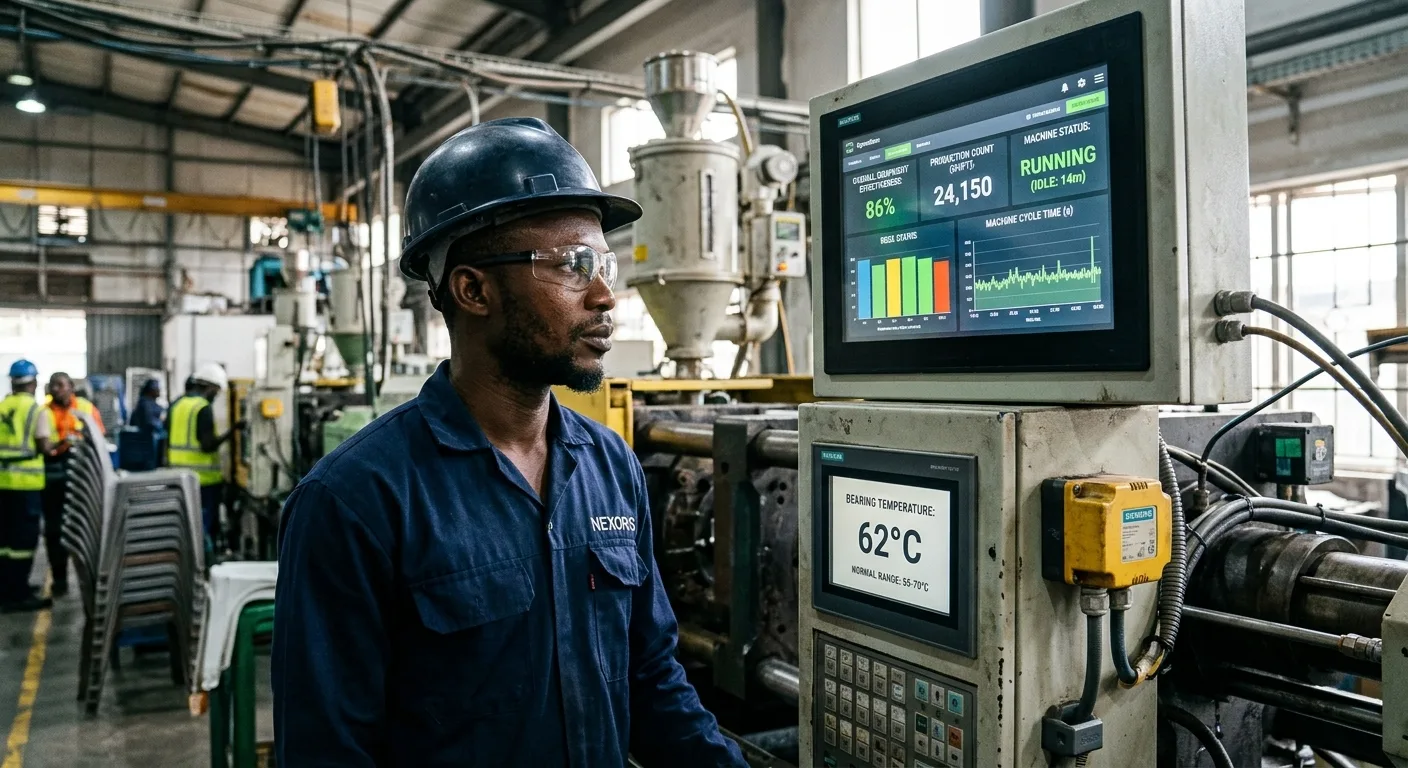
Consider a production machine whose bearing temperature begins to rise above its usual range during a shift. Without monitoring, the problem may go unnoticed until the machine stops. With monitoring, the system can alert the maintenance team while the machine is still operating. The team can investigate the abnormal reading, assess the equipment and decide whether maintenance is needed before the issue develops into a more serious disruption.
2. Predictive and condition-based maintenance
There are three different maintenance approaches:
Preventive maintenance is carried out on a fixed schedule, regardless of equipment condition.
Condition-based maintenance is triggered by the measured condition of the equipment, such as a vibration level passing a set limit.
Predictive maintenance uses historical and current data to estimate the likelihood of a failure and when it may occur.
Vibration, temperature, pressure and operating-hour data can all help maintenance teams spot developing problems. One important qualification applies: a sensor threshold alert is not automatically predictive maintenance. Reliable predictive models need suitable data, validation against real failures and a good understanding of the equipment. Many factories get real value from condition-based maintenance first and move to predictive methods only when they have enough history.
3. Production line monitoring and output tracking
Connected equipment can record:
Production counts.
Machine operating and idle time.
Production interruptions.
Cycle times.
Production targets against actual output.
This gives supervisors a clearer view of what is happening across production lines, without relying entirely on handwritten logs or end-of-shift reports. It also helps answer practical questions, such as which stoppages happen most often and how long they last.
4. Energy consumption and power monitoring
Connected meters and equipment sensors can help manufacturers understand:
Electricity consumption.
Energy use by machine or production area.
Generator operating hours and fuel consumption, where appropriately instrumented.
Unusual consumption patterns.
Energy use relative to production output.
For factories that rely on generators alongside grid electricity, monitoring can help management understand energy consumption across the different power sources. The goal is to understand what energy costs the business, not just to collect electricity readings. Knowing how much energy goes into each unit of output, and when consumption departs from the normal pattern, gives management something specific to investigate.
5. Temperature and environmental monitoring
In food processing, pharmaceuticals, cold storage and other environments where operating conditions matter, connected sensors can track temperature, humidity and other relevant readings. They can send threshold alerts when conditions drift outside an acceptable range and keep historical records that show how conditions behaved over time. Those records are useful for internal quality reviews and for investigating problems after the fact.
6. Quality control and production condition monitoring
IoT data can help identify the operating conditions associated with inconsistent production quality. Examples include machine temperature, pressure, process duration and other production variables recorded alongside each batch. If a defect appears repeatedly during certain conditions, the records give the team a place to start looking.
Camera-based inspection and computer vision can complement sensor-based monitoring, but they are distinct technologies that need their own design and validation. They should not be treated as a built-in feature of a sensor monitoring system.
7. Asset, material and storage monitoring
Connected tracking and monitoring can cover:
Equipment and movable assets.
Storage conditions.
Selected material-handling processes.
Location and movement of tagged assets.
Inventory visibility where devices and systems support it.
IoT tracking complements a properly configured inventory management system. It does not replace one.
The examples below show how these applications can differ by manufacturing environment. They are illustrations only. They are not Nexoris deployments and do not describe any particular Nigerian company.
Manufacturing environment
Example of an IoT application
Food and beverage production
Monitoring processing temperatures and recording environmental conditions
Plastics manufacturing
Monitoring machine temperature, operating hours and production interruptions
Pharmaceutical storage and processing
Monitoring temperature and humidity, with alerts when configured limits are exceeded
Benefits of IoT Development for Manufacturing Businesses
The table below links each operational capability to the benefit it can offer. These are potential benefits. Actual results depend on the use case, the quality of the data and how well the system is adopted.
Operational capability
Potential business benefit
Equipment monitoring
Better visibility into machine conditions
Condition-based maintenance
Earlier identification of equipment problems
Production tracking
More accurate production visibility
Energy monitoring
Better understanding of energy consumption
Environmental monitoring
Improved control of sensitive production and storage conditions
Quality data collection
Better investigation of process variations
Asset tracking
Improved visibility into selected equipment and assets
Reduced unplanned downtime
Early visibility into equipment conditions can help maintenance teams investigate issues before they grow into major disruptions. This does not mean IoT eliminates breakdowns. Some failures give little warning, and some give none that a sensor can detect. What monitoring does is improve the chances of catching problems that do develop gradually.
Better production visibility
Timely, consistent information is more dependable than manual updates and periodic reports. Managers can see the same figures that supervisors see, at the same time, which reduces disagreements about what actually happened on a shift.
More informed maintenance decisions
Equipment history and condition data help maintenance teams prioritise inspections and work orders. Instead of treating every machine the same, the team can focus on the equipment that is showing signs of trouble.
Improved energy and resource management
Monitoring provides evidence for finding waste and for judging whether an operational change made a difference. Without measurements, it is hard to say whether a change saved anything.
Better operational planning and accountability
Reliable records let management compare performance across shifts, machines and periods, investigate recurring problems and make decisions based on consistent information.
Challenges of Implementing Industrial IoT in Nigeria
These challenges are not reasons to avoid IoT. They are design requirements that should be addressed from the start.
Unreliable internet connectivity
If a system depends on a constant internet connection, every network outage becomes a gap in the data. A better design collects and stores readings locally through an edge gateway, then sends them to the platform when the connection returns. This approach is often called store-and-forward. It allows data collection to continue through temporary network interruptions, although some functions, such as remote dashboards, will naturally wait for connectivity.
Unstable power supply
Sensors, gateways and networking equipment all need power. If a gateway switches off every time the grid drops, the monitoring system has a gap exactly when something may be going wrong. Backup power for critical monitoring components, together with sensible device power management, should be part of the plan.
Older manufacturing machines and legacy equipment
Older equipment may not have modern connectivity interfaces. Depending on compatibility, manufacturers may need retrofit sensors, external meters, gateways or other integration methods. Age alone does not decide whether a machine can be connected.
Integration with existing factory systems
Connecting an IoT platform to existing SCADA, PLC, ERP, MES, maintenance or inventory systems can be more demanding than the sensor installation itself. It depends on what interfaces those systems offer and how their data is structured. This should be investigated before the scope is fixed.
Initial investment and implementation costs
Costs depend on the number and type of devices, sensor requirements, connectivity, integration complexity, software scope, installation arrangements and ongoing support. There is no single price that applies across Nigerian factories, and any figure given without an assessment should be treated with caution.
Data security and access control
Connecting machines to a network creates new security responsibilities. A sound design includes:
Device authentication.
Encrypted communications.
Network segmentation, so that a problem on one network does not spread to others.
Clear access permissions for each user.
A process for software updates.
Monitoring for unusual activity.
Secure handling of operational data.
Manufacturers should also consider separating operational technology (OT) networks, which run production equipment, from ordinary business IT networks, with controlled communication between them. This matters most when production equipment is connected to dashboards, ERP platforms or other business applications. The NIST guide to operational technology security (SP 800-82) discusses network segmentation and OT-specific risks, and the IEC 62443 series sets out security requirements for industrial automation and control systems.
Workforce adoption and operational readiness
Operators, maintenance teams and managers need to understand how the system fits into their daily work. If alerts arrive and nobody knows who is responsible for responding, the system will not help. Technology should support existing operational processes, not add complexity to them.
Can IoT Be Integrated With Existing Manufacturing Equipment?
Yes, in many cases, subject to equipment compatibility. Manufacturers do not necessarily need to replace an entire production line to introduce IoT. There are three common approaches.
Using existing machine interfaces: Where equipment already exposes usable data through supported interfaces or protocols.
Adding retrofit sensors: Where extra measurements are needed or the equipment does not provide accessible data.
3. Using industrial gateways: Where machine data needs to be collected, converted or transmitted to another system.
Approach
When it may be suitable
Existing equipment interfaces
Machines expose accessible, compatible operational data
Retrofit sensors
Additional measurements are required or existing interfaces are limited
Industrial gateways
Different equipment and protocols need to communicate with the monitoring platform
Compatibility must be assessed machine by machine. A well-maintained older machine with a usable interface may be easier to connect than a newer one with a closed system. Equipment age alone does not determine whether integration is possible.
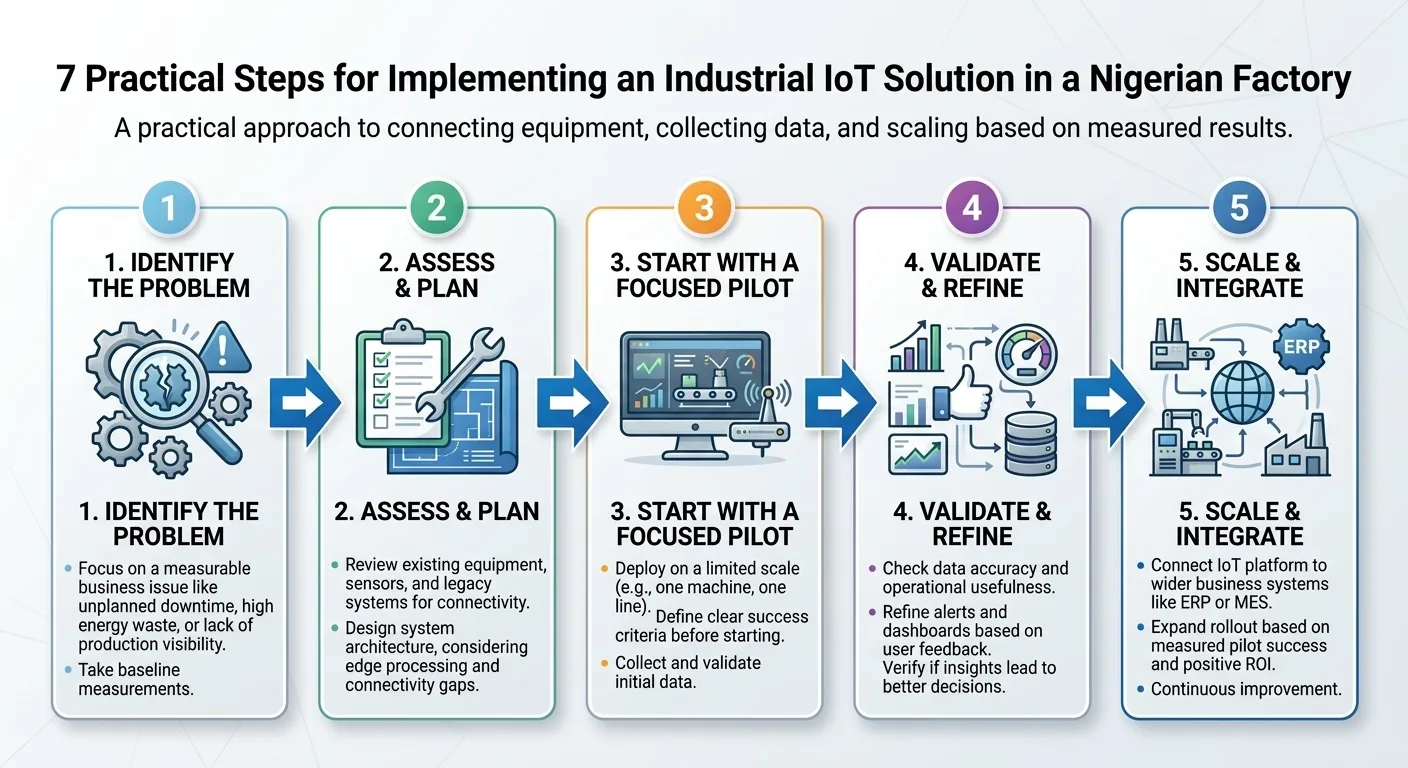
How to Implement an Industrial IoT Solution in a Nigerian Factory
A practical implementation moves in seven steps, from identifying a problem to expanding a proven solution.
1. Identify the operational problem
Start with a measurable business issue, such as frequent machine stoppages, unexplained energy consumption, poor production visibility or temperature excursions in storage. A clear problem makes it easier to decide what to measure.
2. Assess equipment and data availability
Review the machines, sensors, existing interfaces, communication protocols, power arrangements and current software systems. This step often changes the scope of the project.
3. Define the system architecture
Decide which devices, gateways, connectivity methods, processing components, dashboards, alerts and integrations are required, and how the system will behave when connectivity or power is interrupted.
4. Start with a focused pilot
Choose a limited production area, machine group or use case. Define what success means before the pilot begins, so that the result can be judged fairly.
5. Validate data and operational usefulness
Check data accuracy, reliability, alert quality and user experience. Most importantly, check whether the information actually helps teams make better decisions.
6. Integrate with wider manufacturing systems
Where required, connect the IoT platform to production, inventory, maintenance, ERP or business intelligence systems.
7. Expand based on measured results
Use the pilot findings to decide whether to expand the solution, adjust the architecture or add new use cases.
Useful pilot indicators include:
Equipment downtime.
Mean time between failures, where suitable records exist.
Mean time to repair.
Machine utilisation.
Production output.
Energy consumption per unit of output.
Number of relevant alerts and the proportion that were investigated.
Baseline measurements must be taken before the pilot. Without them, there is nothing to compare against, and no honest claim of improvement can be made.
How Industrial IoT Works With Manufacturing ERP and Other Software
IoT platforms sit alongside other manufacturing software and each has a different job:
IoT platforms collect and process data from machines and connected devices.
Manufacturing execution systems (MES) help manage and monitor production execution on the factory floor.
ERP systems manage wider business operations such as procurement, inventory, finance and other resources.
Business intelligence platforms analyse operational and business data to support reporting and decisions.
Here is a practical example. A machine monitoring platform detects an abnormal condition. The maintenance workflow records an inspection request. The maintenance team investigates, and the equipment history stays available for future analysis. Each system does its own job, and the information moves between them without anyone retyping it.
These integrations depend on available APIs, data structures and system compatibility. For businesses planning to connect machine data with wider operations, our manufacturing software solutions cover the business-system side of that work.
What Should You Look for in an IoT Development Company in Nigeria?
When comparing providers, these are the questions worth asking.
Understanding of industrial equipment and protocols
Can the provider assess equipment interfaces, sensors, gateways and industrial communication requirements, or do they only build dashboards?
Ability to develop the complete software platform
Can the provider build the data collection, processing, monitoring, alerting and reporting components your use case needs?
Integration capabilities
Can the provider work with your existing equipment and connect the solution to the business systems you already use?
Reliability, security and connectivity planning
Does the proposed design account for network interruptions, power conditions, data integrity and security?
A clear pilot and implementation plan
Can the provider define deliverables, measurable objectives, testing arrangements and what expansion would require?
Transparent scope and ongoing support
Are hardware responsibilities, software deliverables, third-party costs, maintenance and support explained clearly and in writing?
Manufacturers who want to see how we approach this kind of work can read about our IoT development solutions.
Frequently Asked Questions About IoT Development for Manufacturing in Nigeria
What is industrial IoT in manufacturing?
Industrial IoT in manufacturing is the use of connected machines, sensors and software to collect and present data about production operations. Manufacturers use that data to monitor equipment, track output and conditions, and make better-informed decisions about maintenance and production.
How is IoT used in manufacturing?
Common uses include machine monitoring, condition-based and predictive maintenance, production tracking, energy monitoring, environmental and quality monitoring, and tracking of equipment and assets. The right starting point depends on which operational problem matters most to the business.
Can IoT be installed on existing factory machines?
Often yes, depending on compatibility. Existing machine interfaces can be used where they provide accessible data. Retrofit sensors can add measurements the machine does not supply, and gateways can collect and convert data from different equipment. Each machine needs to be assessed individually.
What sensors are used in industrial IoT?
Common types include temperature, vibration, pressure, flow, humidity, electrical and proximity sensors. Which ones are used depends on what needs to be measured and on the equipment being monitored.
Can industrial IoT work without a continuous internet connection?
Partly. A well-designed system can collect and store data locally, run some processing at the edge and synchronise with the platform when connectivity returns. Not every function will remain available offline. Remote dashboards and cloud-based reports, for example, need a connection.
Can IoT integrate with manufacturing ERP software?
Usually it can, through APIs, middleware or other integration methods, subject to the compatibility of the systems involved. The work needed depends on what interfaces the ERP offers and how its data is structured.
How much does IoT development cost in Nigeria?
Cost depends on the number and type of devices, sensor needs, connectivity, integration work, software scope, installation and ongoing support. A meaningful estimate needs a defined use case, an assessment of the equipment and a clear scope. Be careful with any figure offered before those are known.
How long does it take to implement an industrial IoT solution?
There is no single answer. Timelines depend on equipment compatibility, device procurement, software complexity, integration work, testing and the size of the pilot. A focused pilot will usually take less time than a factory-wide rollout.
Making Manufacturing Operations More Connected With Industrial IoT
Three points are worth keeping in mind.
Industrial IoT gives manufacturers better visibility into equipment, production conditions and selected operational activities.
Its value depends on choosing the right use case, collecting reliable data and fitting the system into real manufacturing workflows.
Nigerian manufacturers should account for existing equipment, power, connectivity, security and implementation costs from the planning stage.
If you are exploring equipment monitoring, sensor integration, production monitoring platforms or other industrial IoT software, we would be glad to talk through your requirements. You can reach Nexoris Technologies Ltd at hello@nexoristech.com.
References and Further Reading
NIST Special Publication 800-82 Rev. 3, Guide to Operational Technology (OT) Security
ISA/IEC 62443 series of standards on security for industrial automation and control systems
OPC Foundation, OPC UA overview
OASIS, MQTT Version 3.1.1 specification, also published as ISO/IEC 20922
Modbus Organization
Share this article
Written by
Chinedu Nwogu
Chinedu Nwogu is the Founder and CEO of Nexoris Technologies with 7 years of expertise in SEO, GEO, and AEO, as well as software and digital products. His background in developing software and digital products informs his approach to designing Industrial IoT systems that account for local infrastructure challenges and equipment connectivity in manufacturing.
Use this guide to calculate your project budget and verify quotes from developers. It includes a breakdown of yearly maintenance costs, which Nexoris Technologies estimates at 15 to 25 percent of your initial build price.
Use this breakdown to estimate your budget based on project complexity, ranging from ₦1.8 million for simple tools to over ₦65 million for enterprise systems.

 Chinedu Nwogu